


Returning to work after a long period of medical leave, this is the story of a single day—and reflections on unlearning survival mode, high-masking, and workplace trauma, while reaching out to any woman who recognises herself in these words.
Yesterday was a good day, so I’ll start there.
I found out who our new manager would be, and we met the company and the manager. For once, it was positive. Reading communication is something I’m good at, and this person seemed to know what they were doing. They respected people, cared about mental health, and prioritized psychological safety at work.
They didn’t spend the time talking about themselves. They asked everyone what they’d like, then carried out what we asked. They spoke about things they’d seen at work and disagreed with, and those values were close to mine. They said they would look after their team, and that if anyone was disrespected, they would take it to higher management. I don’t think I’ve ever had a leader as a manager, rather than just a boss. That meant more than I can say.
One moment from yesterday's meeting stayed with me. A colleague tried to pivot the agenda mid-discussion, but the manager calmly and respectfully held their ground without any edge. The colleague adjusted and stayed on the call.
Coming from a previous environment with that same colleague where toxicity, favoritism, and unaddressed behavioral patterns were the norm, the contrast was striking. It really highlights the impact of strong leadership: when a manager stays fair, consistent, and composed, it completely changes the energy of the room and sets a level playing field for everyone.
Even so, I felt it in my body—a classic trauma response and nervous system dysregulation. I talked fast. I felt I had to get everything out before I lost the floor, as if I wasn’t important. There were things I wanted to say and didn’t, because I was so aware of that person being in the group. They spoke about all the places they’d covered, and I thought, I’ve done the same for years. I didn’t say it.
Looking back: why I talked so fast
If I could sit beside the woman I was in that meeting, I’d tell her this. You rushed because you learned to. After years of being talked over, your body learned a rule: say it quickly, before you lose the floor. Rules like that don’t switch off when the room changes. A better manager and a fairer tone didn’t tell your nervous system the old danger was gone. The hyper-vigilance and the feeling that you weren’t important was an old alarm, not a fact about you.
You can’t talk yourself out of a reflex, but you can notice it, slow your breathing, and remind yourself that this room is not the old room.
The drive
After the meeting, I collected a courtesy car from my insurer. I went to see my parents first, and within the hour I couldn’t stay. I was too excited. I just wanted to drive.
I used to love driving. Somewhere along the way, as my own car got older, the joy turned into worry. It’s a great car and has looked after me for over twenty years, but an older car comes with a low hum of anxiety. Will it break down? Will someone hit it? You start protecting it instead of enjoying it, and slowly you detach.
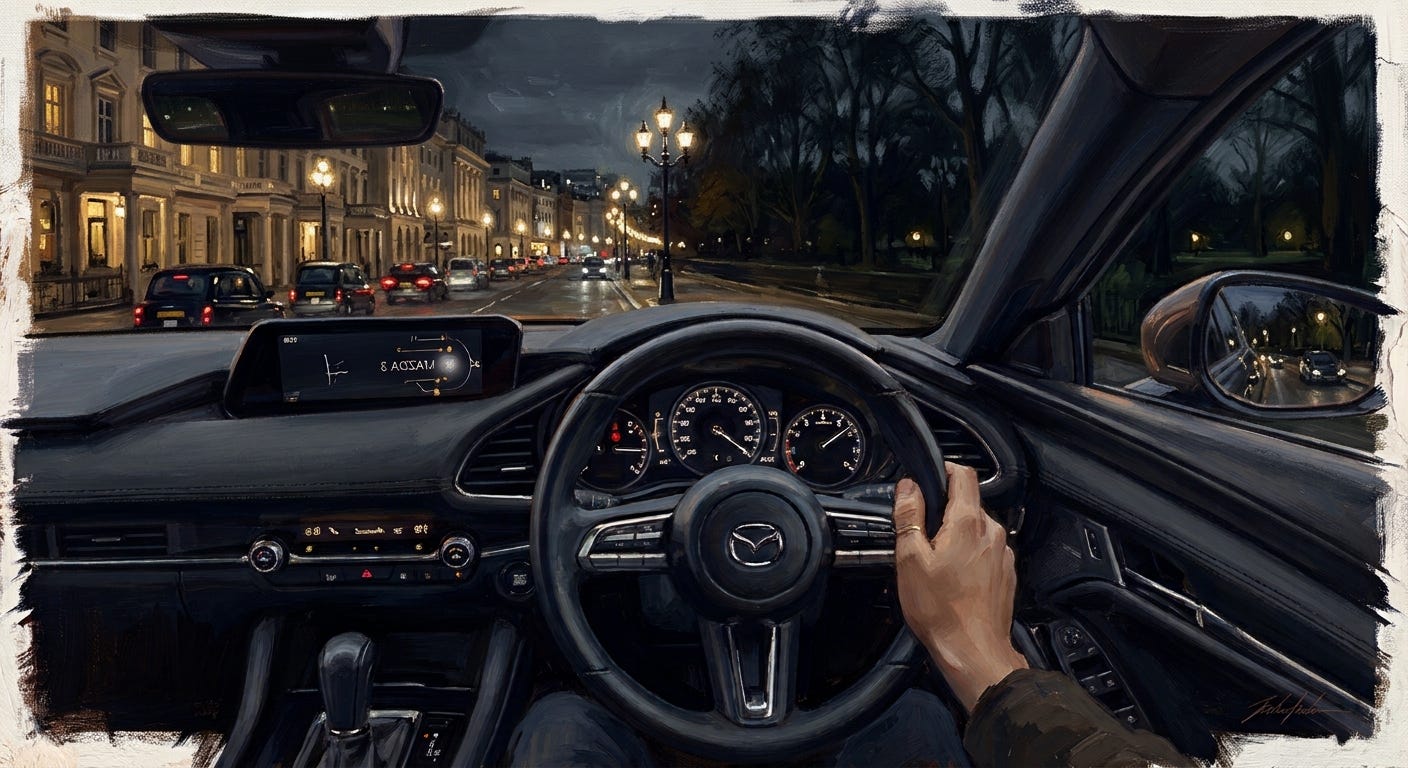
So I took the new Mazda 3 onto the motorway. It felt wonderful just to be in traffic, moving. I stopped at a service station, picked up some food, and parked at the back, the way I always do. During a very hard period of my life, my car was my sanctuary. It was where I went to get away, think, and breathe. Sitting in that quiet car park, looking at a clean black hatchback, I felt a little of that again.
The technology got me too: a bright screen, Bluetooth, a smooth drive. I’ve put a lot of care and money into my own car, but I’d never let myself notice what I was missing.
To the person who handed me the keys, it was just another car. They told me not to worry, that even if I did damage it, it would be fine. That felt strange, because I’m not like that. You’ve trusted me with something, and I’ll look after it more carefully than anyone expects.
Then came the fear. I’d been walked through the damage rules, and I drove away thinking, please, nobody hit me. After what happened to my own car, my mind ran the whole story again. Some of that fear was realistic, because the area I was driving in has a lot of accidents: busy roads, no markings, people stepping out without looking. But some of it was the fear of someone who has been hurt before. Both can be true.
At home I couldn’t park in the grounds, because enforcement there is unreliable and spaces are scarce. I parked a short walk away, somewhere free and safe. I can’t see it from my window, which is one more thing my mind has to hold.
And still, I did normal things. I picked up food. With chronic pain and mobility limits, I didn’t have to stand waiting for a bus. I collected a friend from work, at a place where I used to exercise, and we went shopping and talked. I’d told my insurer these were the things I wanted my life to look like again, and there I was, doing them. It felt unreal.
Looking back: the thing I’d been accepting
Sitting in that car, something clicked: I’ve been accepting less than I deserve for a long time.
I love my own car. But I’d never asked for a courtesy car, because I never thought I needed one. I’d never asked for the easier option or the smoother drive. I was so busy getting by in survival mode that I never asked myself what I wanted. I want a car I can enjoy. And I want to save, so that when mine does reach the end, I have a choice, not a crisis.
To the woman in that car park: low standards become invisible when you live with them long enough. A small taste of something better doesn’t make you greedy. It shows you the gap.
And please stop blaming yourself for the savings you never built. I used to keep a pot for a future car, then dip into it for rent and bills, because when you rely on benefits there is no other cushion. Rent has roughly doubled over the years, and the support hasn’t. When there’s nothing left after the essentials, a savings pot gets spent on living. That wasn’t a personal failure. It was survival.
I asked myself the honest question that day: what could I have changed? Not my home. Not the rent. The one thing was my job, and the chronic stress that came with it. I worked four days, but it consumed my whole week. Hidden disabilities and burnout do that, but it wasn’t only that. The company saw clock in, clock out, hit your targets, here’s your plan, off you go. There was no real workplace support, and over time that took a lot from me, including the money I never got to keep.
I’m not writing this to complain. I’m writing it because I finally faced it.
When the evening came
When I got home, everything started pouring out.
I have a one-to-one meeting with my new manager coming up, and my mind wouldn’t stop writing the script. I kept thinking of things I should have said. I kept thinking, they need to know, and then, how much is too much?
Part of why I couldn’t settle is that nothing from my last workplace was ever resolved. I experienced serious health and safety failures and harassment, and I struggled through them without help. One colleague said they were sorry to hear what I’d been through, and added that I wasn’t the only one. That’s probably true, but it isn’t the same as an employer taking responsibility. No one was accountable, no one apologised, and the loop stayed open. Now I’m returning to similar work in a new organisation. Of course my body is on alert. I may not have fully healed from that workplace trauma, and I don’t think anyone truly sees me.
I want to say plainly what “hidden disabilities” means for me, because I only understood it a year or two ago, and it explains a lot. I have late-diagnosed ADHD and CPTSD. I mean the real thing, not the version people joke about online. It’s running at a hundred miles an hour or complete executive dysfunction. It’s a cycle that repeats when you keep ending up in the same rooms with the same toxic dynamics. I’ve realised I’ve spent years exhausting myself in the wrong ones.
I don’t play the victim, and I do my best every day. But I wear a professional mask so well—high-masking neurodivergence at its peak—that no one knows I’m not okay. They see a capable, polite person. They don’t see that I’m struggling with basic needs, that my sleep is a mess, that I have no social life, and that I haven’t been able to recover because every workplace that didn’t look after me made it worse. Family made it worse too, with the idea that everything will be fine if I just get a job.
People around me are focused on their own struggles, and I’m usually the one who notices it in others. I don’t want constant monitoring or assumptions. I’d like someone to ask, how are you? I also can’t do a rigid nine-to-five. I prefer being in an office, and I’m learning where my physical limits are. That isn’t an excuse. It’s information.
I grew up in a family where everyone else came first, and I’ve found the same pattern in teams: “who’s suffering more” is not a place where you feel safe asking for help. So for now, my hope rests mostly with a leader who leads by example. I’m not putting everything on one person. I’m just hoping.
I know myself. I’m professional. I don’t gossip, and I know when something is too personal to share. I’ve seen people handle their struggles very differently from how I handle mine, and I’ve learned that my own way is quiet. But that creates its own trap: I’m so careful that nobody sees what I’m carrying. I’m confident and capable, with a strong professional background, so people assume I’m fine.
If I could say it all, I’d say this. I work a few days a week because I have to pay the rent. I have no savings, and I’m one paycheque away from a very bad place. I’ve said that to people who could help and been signposted, again and again, with nothing happening. Public transport is hard, and long journeys aren’t something my body can do. What I’m hoping for isn’t a quick fix. It’s someone who understands, and some guidance along the way.
A friend put it perfectly: you’re scared to be honest because every time you get slightly honest, you trigger that Rejection Sensitive Dysphoria where no one does anything and no one takes it seriously. And you don’t want that with this person. You want a little bit of hope.
That’s what’s under all of it.
Looking back: why it all came out at night
To the woman at her kitchen table that evening: all day, you coped. You held it together, said the polite things, and wore the mask. Then you got home, and it all came out.
That isn’t falling apart. For many of us, with trauma, CPTSD, and neurodivergence especially, the nervous system waits until it’s safe before it processes anything. Plan for the delayed reaction. Leave space after big days, eat something, drink some water, and let the evening be quiet.
Looking back: why hope was the scary part
Here’s the strangest thing I’ve learned: good news can be harder to hold than bad news. When you’ve been honest before and nothing happened, or you were told you were catastrophising, or everyone else’s needs came first, hope starts to feel risky. You looked at a manager who seemed decent and thought, please don’t let me be let down again.
That fear isn’t a weakness. It’s protection that made sense once. You don’t have to throw it away. You can test it, in small steps, with people who earn it.
Looking back: the loop that wouldn’t close
Not being apologised to or taken seriously is its own injury, on top of the original one. You may never get closure from the people involved in past workplace harassment, and that’s unfair. But closure can come from other places: a therapist who understands trauma, a trusted friend who simply believes you, or formal options for past safety failures through organisations like Citizens Advice or Acas. I’m not a lawyer, so treat that as a starting point.
What I’d tell you to say to a manager in a 1-on-1
You had too much to say. You were afraid that if you said none of it, they’d never understand you, and if you said all of it, you’d be “too much.”
Here’s what helps. Think of it as a user manual for working with you, not a confession.
Sort it into three piles: Must say is what you need in order to work well and maintain psychological safety. Could say later is the background. Belongs elsewhere is what you process with a friend, a therapist, or a journal. Only the first pile goes into the one-to-one.
Pick two or three points, not twenty. The rest can wait for a second conversation.
Bring your notes. “I’ve written a few things down so I don’t forget” is professional, and it frees your mind from holding everything at once.
Name the one thing you most need. For many high-masking women, it’s simply being asked, how are you?, directly, because we mask so well that nobody can tell.
Ask for practical workplace accommodations. Clear communication in writing, time to process requests, flexibility around travel, or exploring formal routes like Access to Work or Occupational Health. It’s worth asking what reasonable adjustments exist.
Address past team dynamics professionally. If a difficult colleague is around, you don’t owe anyone the history. You can say: “I had a difficult working relationship with someone on this team before, and I’d like to be able to raise things early if they come up.” That gives your manager what they need without sounding like gossip.
Watch how they respond. If they listen, take notes, or say “thank you for telling me,” that’s a good sign. Let trust grow from evidence, not from hope alone.
Say the small brave thing. At the car hire desk, I said, “I have hidden disabilities and I need a little longer.” It’s a full sentence. It needs no apology, and it worked.
Beyond the conversation
If your mind loops, try a worry window: ten minutes at a set time to write everything down, then stop.
If basic self-care and sleep are slipping: tell a GP, not only your manager. You shouldn’t have to hold burnout alone.
Build a circle outside of work: A manager can adjust a workplace, but they can’t be your only support system. Build a small circle outside work: a therapist, a peer group, or one trusted friend.
On money and advocacy: If you’ve been signposted over and over with little result, ask one organization for one specific next step, not another list.
Keep noticing what you want: The drive, the ease, the better thing. You’re allowed to want better.
Questions to sit with
What would you say if you knew it would be taken seriously?
What do you do to feel safe that other people never see?
Where have you had a small piece of good news and immediately braced for the fall?
What have you stopped asking for because it never seemed available?
What did you used to love that anxiety slowly took over?
To the woman reading this
If you talk fast, hold back, replay everything at night, and wear a mask so well that nobody asks how you are, you are not broken. You are someone who learned to survive being unheard.
The work now isn’t to become quieter, or louder, or tougher. It’s to find the rooms where you can slow down, and the people who ask how you are and wait for the answer.
You deserve both.