


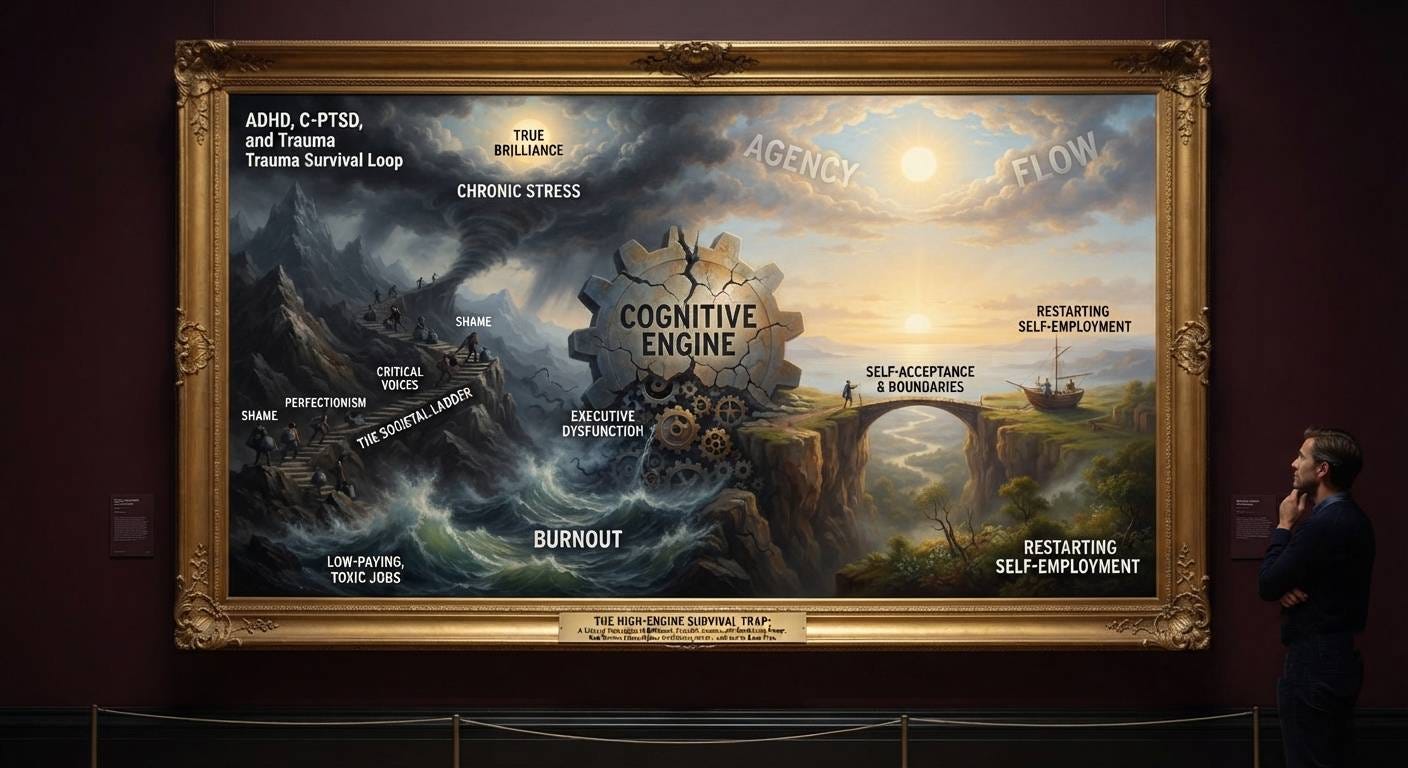
Have you ever looked at your life and wondered, “If I am so capable, why am I struggling to survive in a low-paying job?” Told you were capable but struggling to survive in survival mode?
You aren’t lazy, and you aren’t lacking intelligence. If you grew up in a chaotic home, survived hostile school environments, and now struggle with focus despite having brilliant real-world instincts, you may be experiencing the intersection of High IQ, ADHD, and Complex PTSD (C-PTSD).
This is the story of how unrecognized brilliance gets trapped in survival mode—and how to finally break free.
The Roots: How Childhood Stress and C-PTSD Hijack the Brain
To understand why a high-performing mind stalls in adulthood, you have to look at the environment that shaped your nervous system.
Living in a home defined by financial scarcity, unpredictable emotional outbursts, or generational family pressure forces a child’s brain into chronic hypervigilance. When home life requires you to constantly scan for threat levels, your nervous system never enters a state of rest and safety.
Chronic Childhood Stress / Bullying (C-PTSD)
│
▼
Nervous System Locked in Threat Mode
│
▼
Prefrontal Cortex Downregulated (Memory & Focus Suffer)
│
▼
Labeled “Slow” or “Careless” Despite High Intelligence
When you step into school environments plagued by social cruelty and bullying, survival becomes your sole priority. The brain prioritizes safety over linear academics:
Physiological Deprivation: Skipping meals, lack of sleep, and chronic stress rob the brain of essential fuel.
Brain Fog & Executive Shutdown: When stress hormones like cortisol flood your system, the prefrontal cortex—responsible for working memory, maths, and structured processing—temporarily shuts down.
The “Careless” Label: Adults often misinterpret nervous system overload as laziness or low ability, instilling deep-seated academic shame.
Real-World Intelligence vs. Academic Tests: Understanding Twice-Exceptionality (2e)
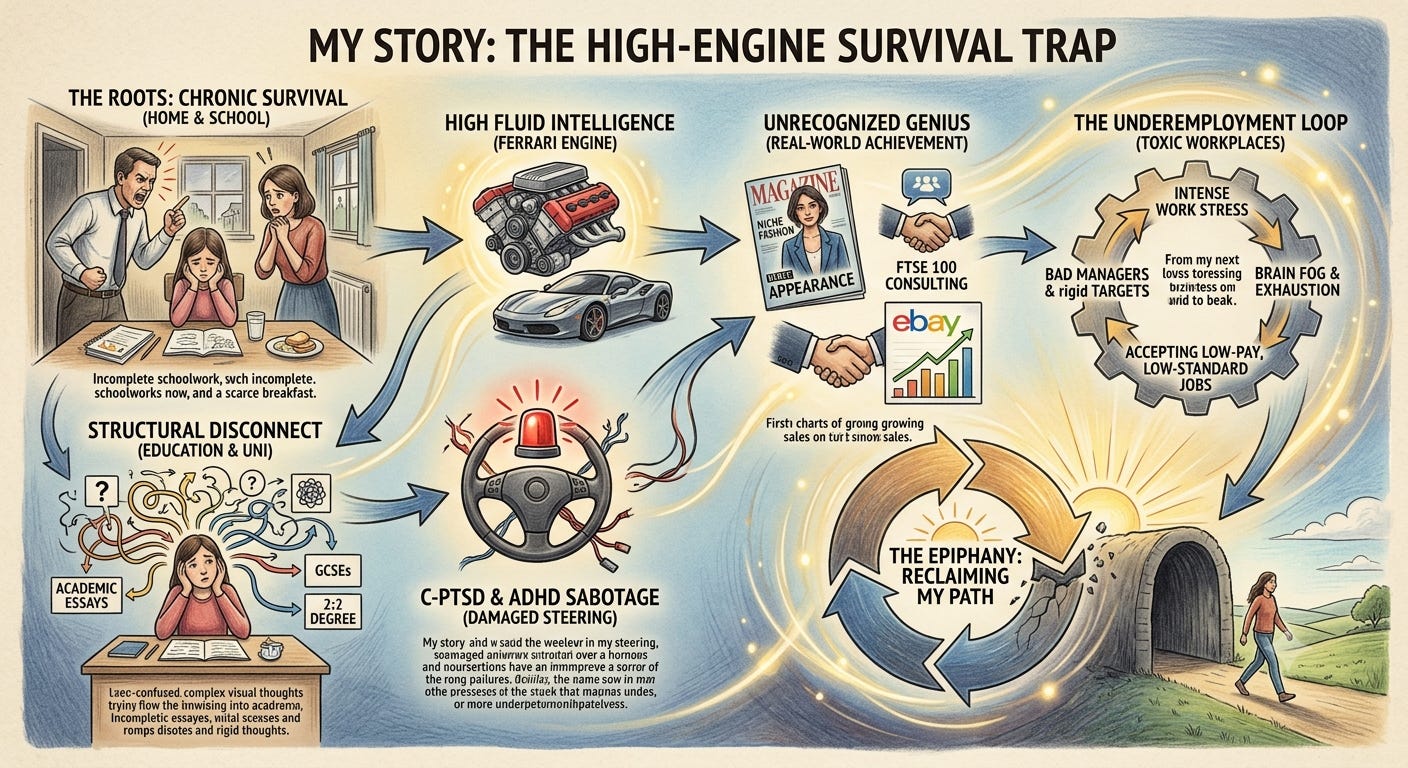
Standard education and traditional IQ tests measure a very narrow type of logic (convergent thinking). They judge your worth on sitting still, following rigid steps, and converting thoughts into linear essay structures.
However, real-world intelligence often operates on high fluid and practical intelligence (divergent thinking):
Street Smarts & Pattern Recognition: Reading people, sensing market demands, and seeing systemic connections instantly.
Entrepreneurial Instincts: Spotting business opportunities, launching ventures, sourcing products, and visualising creative solutions out of thin air.
High-Level Strategy: Mentoring others, consulting on complex projects, and driving innovation.
When high fluid intelligence coexists with ADHD and trauma, it is known in adults as Twice-Exceptionality (2e). You possess a high-powered cognitive engine, but executive dysfunction and a hyperactive alarm system make standard paper tests and rigid academic environments feel like an impossible uphill battle.
The Societal Lie: The Myth of “The Top,” Flashy Cars, and High Taxes
From primary school onwards, society feeds us a compelling narrative: work harder, compete to be top of the class, get the prestigious job, buy the big house, and drive the luxury car.
We are conditioned to believe that climbing this ladder is the definition of intelligence and success. But having experienced both high-income entrepreneurship and lower-income employed roles, many smart people uncover a sobering truth: it is a trap.
Societal Pressure: “Climb to the Top” (Big House, Flashy Car, High Title)
│
▼
Extreme Work Pressure, Long Hours & Chronic Burnout
│
▼
Higher Income Bracket ➔ Heavily Eaten by UK Income Tax & National Insurance
│
▼
Exhausted, Disconnected from Self & Open to Manipulation
The Financial Illusion: In places like the UK, moving into higher earnings brackets comes with steep marginal Tax and National Insurance (NI) rates, alongside the sheer cost of maintaining an expensive lifestyle. You work twice as hard for diminishing returns, spending your highest-value cognitive energy just to service debt and bills.
The Loss of Self: Chasing external prestige forces you to ignore your internal signals. You end up trading your health, mental clarity, and peace for a title or a status symbol that doesn’t actually soothe a traumatised nervous system.
The Boundary Trap: When you don’t know your own internal worth, high intelligence can actually work against you. Intelligent, empathetic individuals who lack firm emotional boundaries often let people with lower IQ or poor Emotional Intelligence (EQ)—such as manipulative managers, toxic partners, or parasitic family members—take advantage of their energy and talents.
What the Research Says: Does High IQ Actually Make You Happy?
We are taught that being smarter automatically leads to a better life. Psychological and epidemiological research paints a much more nuanced picture:
IQ Does Not Equal Happiness: Multiple large-scale psychological studies across the UK and internationally demonstrate that individual IQ scores have virtually zero direct correlation with subjective daily happiness or overall life satisfaction. Being the smartest person in the room does not protect you from depression, anxiety, or burnout.
Income Has a Ceiling for Well-Being: While moving out of poverty significantly reduces distress, research consistently shows that once basic financial safety is secured, additional income yields diminishing returns on happiness. A higher salary cannot offset a toxic workplace or a chronic C-PTSD threat response.
Emotional Intelligence (EQ) Trumps IQ for Fulfillment: Research published in well-being psychology highlights that Emotional Intelligence (EQ)—specifically self-acceptance, emotional regulation, autonomy, and boundary-setting—is a vastly stronger predictor of life satisfaction and mental health than raw IQ or socioeconomic status.
The Underemployment Loop: Why Traumatised Minds Accept Low-Standard Work
Why do individuals who build businesses, run niche magazines, or advise high-level leaders end up trapped in toxic, low-paying jobs with micromanaging bosses?
Past Trauma & Academic Shame
│
▼
Belief: “I’m broken/only average”
│
▼
Accepting Low-Pay, High-Stress Jobs
│
▼
Unsupportive Managers & Heavy Targets
│
▼
Brain Fog & Exhaustion (Re-traumatization)
│
▼
“See? It must be my fault.” (The Lie)
Internalised Shame: Growing up surrounded by shouting or criticism creates a subconscious belief that you are “difficult” or “only average.”
Familiarity with Dysfunction: Toxic, target-obsessed workplaces mirror childhood chaos. Your traumatised nervous system mistakes the stress for “normal.”
Bandwidth Depletion: Managing ADHD executive dysfunction alongside an active C-PTSD threat response consumes immense daily mental energy. By the end of the workday, you have zero fuel left to build an exit strategy, write a portfolio, or pitch higher-value clients.
Conclusion: Seeing Differently, Breaking Entrapment, and Restarting on Your Terms
True intelligence isn’t about fitting into society’s pre-packaged boxes or accepting what you’ve been told to want. It is the ability to see things differently, question the narrative, analyze human behavior, and spot underlying patterns that others completely miss.
When you possess this perspective, you realize something fundamental: Money alone does not make us happy.
True fulfillment doesn’t come from a bigger paycheck or societal status. It comes from:
Moving from feeling hopeless to feeling hopeful.
Shifting from feeling limited to feeling limitless.
Breaking free from entrapment and gaining genuine control over your daily life, instead of living trapped by the shadows of your past.
Feeling free with your time and choices is priceless and without any shackles!
After five years of stepping away from self-employment and putting my creative drive on hold to survive in low-standard workplaces, the clarity has returned. Happiness comes from honoring what I genuinely want and need, looking after my mental health, and channeling my passion into building something that is mine.
Restarting self-employment isn’t just a career shift—it is reclaiming my agency, using my analytical vision to solve real problems, and living life entirely on my own terms.
Frequently Asked Questions (FAQ)
Can you have a high IQ and still experience severe brain fog?
Yes. High IQ refers to raw processing capacity and pattern recognition, whereas brain fog is driven by executive dysfunction (ADHD) and chronic nervous system hyperarousal (C-PTSD). When stress levels are elevated, the prefrontal cortex downregulates, making it difficult to access your high intelligence in daily tasks.
Why do smart adults with ADHD and C-PTSD end up underemployed?
Trauma and neurodivergence often lead to low self-worth, academic shame, and chronic cognitive exhaustion. This combination frequently causes high-ability individuals to accept low-paying, highly structured, or toxic roles because their survival-focused nervous system prioritises immediate stability over risk-taking and self-advocacy.
What is the difference between test intelligence and practical intelligence?
Standardised tests measure convergent, linear logic in controlled settings. Practical intelligence involves lateral thinking, adaptive problem-solving, reading social dynamics, visualising complex systems, and executing ideas in dynamic, unpredictable real-world environments.
Does having a high IQ guarantee career success and happiness?
No. Psychological studies show that raw IQ has little to no direct correlation with personal happiness or life satisfaction. High IQ can grant problem-solving abilities, but without emotional intelligence (EQ), trauma recovery, and supportive environments, high-IQ individuals frequently suffer from burnout and underemployment.
Why do high-IQ individuals allow people to take advantage of them?
High intelligence does not automatically equal strong boundaries or high self-esteem. Individuals raised in traumatic or invalidating environments (C-PTSD) often develop people-pleasing habits and hypervigilance. They may use their high IQ to solve other people’s problems while neglecting their own emotional boundaries, making them targets for manipulative individuals.
How does restarting self-employment help overcome executive dysfunction and burnout?
Self-employment allows high-fluid-intelligence individuals to design their own schedules, eliminate toxic management dynamics, and work with their brain’s natural momentum rather than fighting rigid corporate structures.
It shifts the focus from survival and compliance back to autonomy, passion, and creative control.
Ready for 1:1 support?
The Rapid Reset Strategy Intensive is a private, 90-minute strategy reset for anyone navigating toxic workplaces, ADHD masking, burnout, or career pivots. Backed by 20+ years of corporate strategy, you’ll get immediate clarity and an exact execution blueprint.