


Maybe you have a diagnosis. Maybe you suspect something but have never been assessed. Maybe you’re simply stressed, overwhelmed and tired in a way sleep doesn’t fix. Whichever it is, this story is for you.
If work has been hard and nobody helped, I’m sorry. You deserved better, and it was never your fault.
I live with C-PTSD and ADHD. You can’t see either from the outside, and I’ve spent years being very good at making sure you couldn’t. I’m not a medical professional, and this isn’t advice. It’s my story, and what it taught me.
Where the fear comes from
For a long time I worked in places that weren’t good for me. Some were toxic. People took advantage of how capable and professional I was, and the more I coped, the more was expected. Targets and pressure put me at risk, and things that could have been avoided weren’t. Nobody asked, “What’s going on?” or “How can we help?” I was expected to be reachable at any moment, with no way to switch off. When I needed support, it wasn’t there, and nobody followed up.
So I did what capable people do. I carried on, looked professional and said I was fine.
Burnout doesn’t only exhaust you. It takes away the energy you’d need to leave. I should have moved on sooner, but I had nothing left to look for something better. For years I believed that was my failing. It wasn’t. It was workplaces that never checked in, and that kind of experience stays in your body.
Have you ever stayed somewhere too long, not because you wanted to, but because you were too tired to go?
The day before
On Day 12 of my diary, I went back to work in the middle of big organisational changes. There were two training courses, a mountain of new documents to make sense of, and a lot of anxious people saying there was no support. I understood the worry, but it was heavy to be around, so I decided to protect my energy and go at my own pace.
My first proper conversation with my new manager was coming up, and my mind wouldn’t leave it alone. Around half past four it ran away with me. For ninety minutes I rehearsed worst cases. What if no one listens, like last time? What if I’m honest and it goes badly? What if I’m treated the same as before?
I had made it really big. I had so much to say about my disabilities and my past, and no idea where to begin. I wrote reams, saying the same thing ten different ways, trying to find something that would close the loop. Nothing did.
Then, at five past six, I started cooking salmon with kale and peas. The spiral eased. Earlier I’d made egg bread, and there was watermelon too. I’d also forgotten to drink any water, even with the bottle right beside me, which is very ADHD. But I noticed what I’d done well, and I was proud of it.
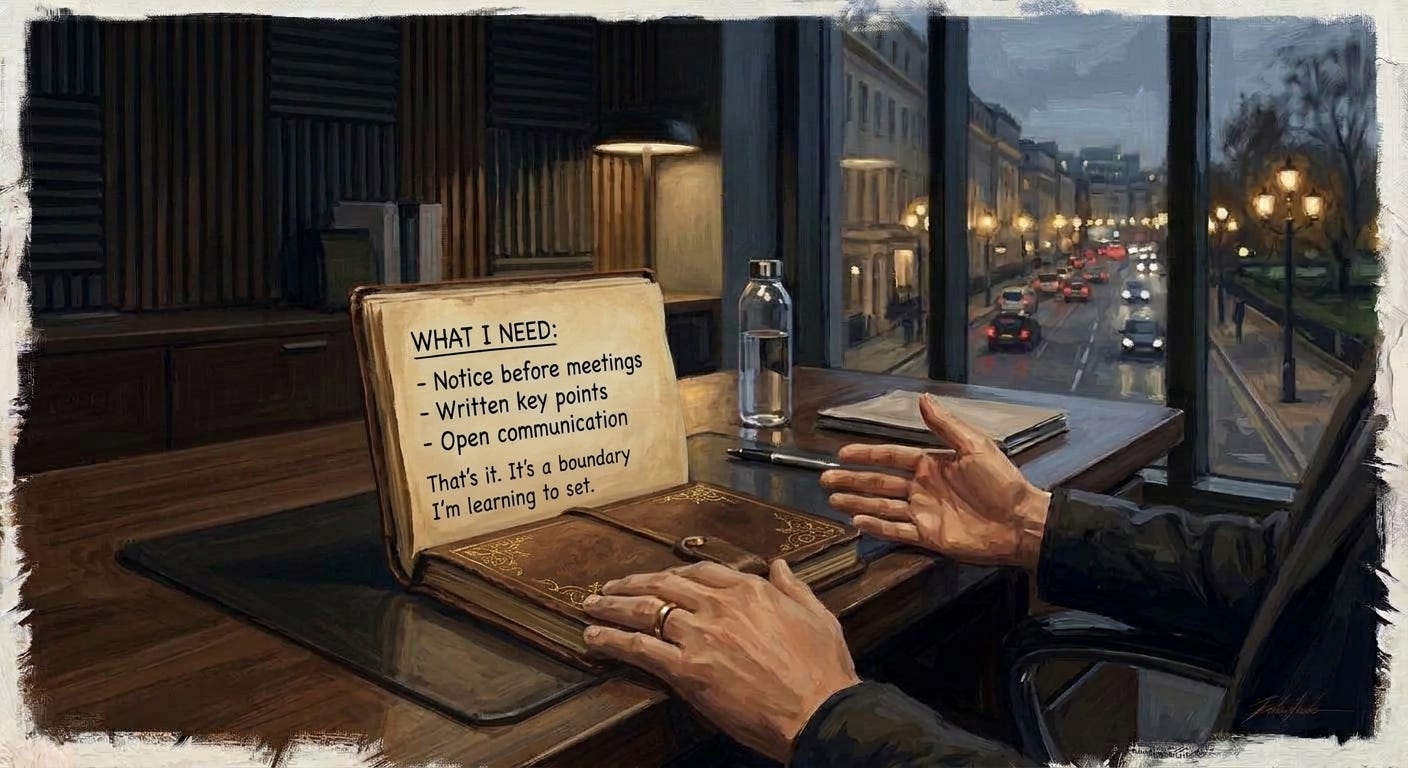
My biggest win was a quiet one. I wrote down what I needed, and I didn’t push myself, even with a full diary of meetings and a short working week. It’s a boundary I’m learning to set with myself before I ask anyone else to respect it.
What small thing did you do for yourself today that you haven’t given yourself credit for?
What I realised about over-preparing
Looking back, I over-prepared because the trauma of my old workplace was still within me. My nervous system was treating a new manager like the old situation, as if he might treat me the same way. That isn’t dramatic or irrational. It’s what a body does when it has learned that speaking up isn’t safe.
And here’s what I needed to hear, so I’ll say it to you too: it’s normal to feel like this. It’s okay. You’ve got this.
You don’t need a speech. You don’t need to explain your whole history. A conversation like this can feel like a coffee catch-up, with one or two honest things said plainly.
A loose script, not a speech
If you’re facing a similar conversation, this is the shape I settled on. Use your own words and let the conversation flow.
Open warmly.
“Thanks for making time. I wanted a proper catch-up, partly so we can get to know how each other works.”
Say the one or two things he needs to know.
“I have some hidden disabilities, ADHD and C-PTSD. You wouldn’t see them from the outside, but they affect how I work best. I’ve also had a difficult experience in a previous workplace, where I wasn’t supported. It’s made me a little wary, so I’d rather be open with you from the start.”
I kept the old workplace to that one sentence. He needed context, not the history.
Say what helps, briefly.
“A few things help me do my best work: notice before meetings where possible, a message first for anything non-urgent, and key points in writing so I can process them properly.”
Talk about moving forward.
“I’m not expecting you to have all the answers. I’d like us to work well together, and if something isn’t working on either side, I’d rather we raise it early and directly. A quick chat or a message is fine.”
Hand it back.
“What does good working together look like for you? Is there anything you need from me?”
That last question matters. It shows you’re thinking about his needs too, and it turns a disclosure into a two-way conversation. If he needs to do paperwork, you can offer to put things in writing for his records.
If you stopped explaining yourself and simply listed what helps, what would be on your list?
The next day
It went better than I feared. He listened, asked what would help, and agreed to give me notice before meetings. It wasn’t dramatic, but I felt heard, and that was new.
He talked through what he needed from me, and I was mindful not to dump everything on him. I tried to find a balance and just said what I needed. I don’t think he fully understood, but I could tell he was trying. What I realised is that people don’t always see it, so I had to put it forward and advocate for myself from the beginning. Nobody was going to do that for me, and this time I did.
I came away feeling heard, though I noticed I’d have liked him to ask a little more. I’ll come back to that.
How I felt afterwards
Once it was over, I asked myself the questions I’d suggest to anyone: did I feel heard, what did I like, and what didn’t sit quite right?
What I liked
He led the conversation, so I didn’t have to carry it.
He gave me space to say what I needed to say about my hidden disabilities.
I didn’t feel dismissed, which was my biggest fear.
He reassured me that his team’s wellbeing matters to him, and that health comes first.
What I didn’t love
He didn’t ask much more, and he didn’t make it feel like a big deal. I’d have liked a follow-up question or two, to show he understood how much it meant to say it.
But I could tell he took it seriously, and the reassurance was real. Both things can be true. He can be trying and still not fully understand yet, and that gives me something to build on. If I want more, I can offer it gradually as trust grows, and I can ask for a check-in later.
Is there someone in your working life who has shown you they’re safe? What would you say to them if you started small?
What my body remembers
I wish I could wake at half past seven and have time to myself before the day begins. Instead I snooze, shattered, until the last possible minute. I’ve always been like this, and for a long time I thought it was laziness.
I now think it’s partly biology and partly memory. ADHD often comes with a late body clock, and trauma can keep you on guard at night. If mornings once meant bracing for a call, or walking into a workplace that didn’t look after you, your body learns to dread them. That’s protective, not weak.
What’s been learned can be softened, slowly, through small, safe experiences: a warm drink, curtains open, a steady wake-up time. If it’s been this way your whole life, it’s worth mentioning to your GP.
Not diagnosed? Just exhausted? You still count
You don’t need a label to deserve support. If you’re always stressed, struggling to switch off, dreading mornings or running on empty, that’s reason enough to ask for help. I can’t tell you what’s going on for you, but a GP appointment is a good first step, and it helps to write down what’s been happening and for how long.
In the UK, you generally don’t have to tell an employer about a disability, but they only have to make reasonable adjustments if they know, or could reasonably be expected to know. The Equality Act looks at how a condition affects your daily life, not just the name on it, and conditions like ADHD and C-PTSD can count. You can start with what helps rather than a diagnosis, tell one person you trust, and get what you agree in writing. ACAS, Citizens Advice and Access to Work are good places to start. This isn’t legal advice.
What I learned
It’s normal to feel like this. If you’ve been let down before, fear of it happening again is a sensible response, not a flaw.
Fear from the past isn’t proof about the present. Not being listened to before doesn’t mean it will happen again.
You don’t have to make it big. One or two honest things, said plainly, are enough to begin.
Advocate for yourself from the start. People don’t always realise what you need, even kind people who are trying. Saying it plainly isn’t dumping. It’s how support begins.
Not fully understood is not the same as not supported. Someone can be trying and still need time to learn. Watch what they do, not just what they say.
Afterwards, ask yourself how it felt. Did you feel heard? What did you like, and what didn’t you? It helps you decide what to say next time.
Being competent can hide how much you’re struggling. Looking fine is not the same as being fine.
Burnout takes the energy you’d need to leave. Rest and support come first. The big decisions can wait.
Your body remembers, and it can learn new things. Small, safe experiences change what mornings, phones and meetings mean.
You don’t need a diagnosis to deserve help. Stress that never lets up is reason enough to ask.
You don’t have to tell everyone everything. Share what helps, and more as trust grows.
When you’re going round in circles, the loop needs an action, not more words. I wrote reams. One small step closed it.
Agree early how you’ll handle issues together. It’s easier to talk when nothing has gone wrong yet.
Notice the small wins. A cooked meal, a boundary kept, a day survived.
Let things surface, make a note, and move on. You don’t have to process everything in one night.
What others need to know
To managers: Ask “What’s going on?” and “How can we help?”, then follow up. Quiet doesn’t mean fine. Give notice before meetings, message first when something isn’t urgent, and put key points in writing. When someone trusts you with something personal, ask a gentle follow-up question, because it shows you understand what it cost them to say it. Treat adjustments as a right, not a favour, and keep disclosures private unless someone says otherwise.
To colleagues: Anxiety spreads during big changes. Someone who looks fine and delivers on time may be paying a huge cost to do it. Don’t decide who deserves help by age, seniority or how long they’ve been there.
To anyone struggling: You’re not lazy, difficult or dramatic. You adapted to places that didn’t look after you. You’re allowed to ask for what you need, in your own words.
A letter to future me and readers
If you’re reading this, you probably needed help, and I hope you got it.
You’re not too much, and you’re not difficult. You adapted to workplaces that didn’t look after you, and you kept going. That took strength.
If you’re making something big in your head again, remember Day 12. You were frightened, you over-prepared, you cooked your dinner, and the next day you said what you needed anyway, and it was okay. It’s normal to feel like this. Your body remembers the bad times, but it can learn good ones too, slowly.
Ask for help earlier than feels comfortable. Keep water by the bed. Open the curtains. Protect your time, because it’s yours. Leave places that drain you before you’re empty. And if someone shows you they’re safe, let yourself believe it a little.
You’ve got this. You deserve a peaceful life. Keep going.
After the conversation: let it settle
After a conversation like this, things will come up. You might replay it, second-guess what you said, or feel a bit raw or flat. That’s normal, and it’s fine.
Distract yourself. You don’t have to analyse it straight away. Go for a walk, cook something, put on a programme, call a friend.
When something surfaces, make a note and move on. Jot it down in your phone, then let it go. You can come back to it later.
Journal if you need to. Ask yourself how you felt, whether you felt heard, what you liked and what you didn’t. Write it down without judging it.
Don’t fix everything at once. You’ve said the important thing. The rest can come in time, in small conversations.
Be kind to yourself. Feeling a bit wobbly after being vulnerable is not a sign it went wrong. It’s a sign you did something brave.
It’s normal to feel like this. It’s okay. You’ve got this.