


For two decades, I’ve worked across nearly every corner of the professional world—from the public sector to fast-paced marketing agencies, and from small startups to some of the largest Top 250 global corporations in the UK and worldwide. As a business growth specialist and trainer, I’ve advised CEOs, kept struggling companies afloat through digital transformations, and helped everyday people take their ideas to market.
Over the last three years, after returning to formal employment, I stepped directly into my work as a Career Crisis & Startup Advisor. Day in and day out, people come to me when their professional lives have completely collapsed—when burnout paralyses them, when toxic management pushes them to the brink, or when masking inside traditional corporate structures becomes physically impossible.
What most of my clients don’t know, until now, is that I didn’t learn how to guide people through these crises solely from corporate boardrooms or policy handbooks. I learned it because I lived it.
For 33 years, I was trapped in my own head, fighting a quiet, internal war against systems and expectations that were never built for my brain.
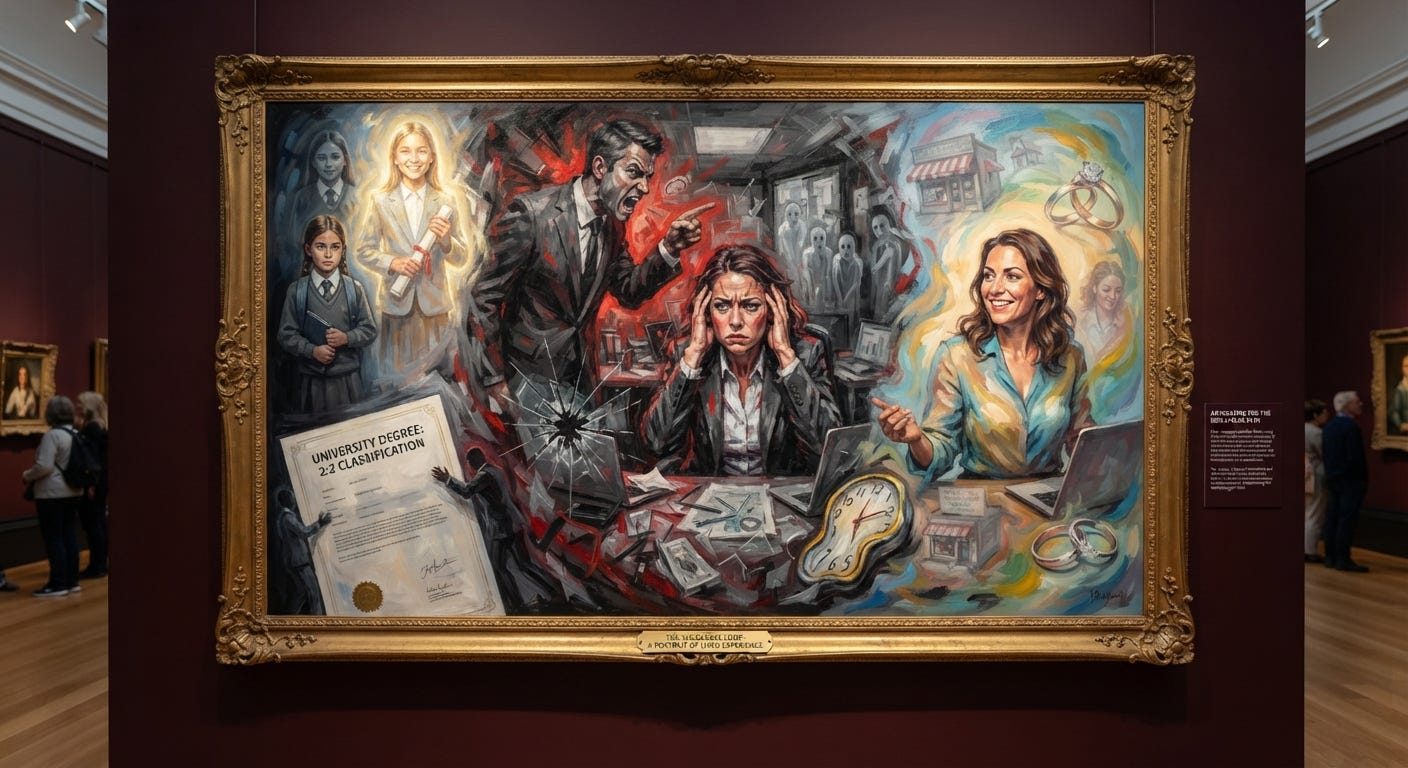
The Childhood Shadow: Sibling Comparisons and the 2:2 Filter
The journey of feeling “less than” rarely starts in the workplace; it usually begins long before we ever sign an employment contract.
Growing up, I was an average student, living in the shadow of high achievement. My sibling—separated from me by only a single year in age—was a scholarship student, hitting every benchmark: top grades, predictable success, and eventually early home ownership.
When you grow up in an environment where standard academic achievement is elevated above all else, subtle psychological dynamics take root. You are quietly conditioned to believe that you aren’t as smart, as capable, or as worthy. It is a quiet form of psychological invalidation that teaches you to doubt your intelligence before you even get a chance to test it in the real world.
That belief followed me straight into adulthood. When I looked at applying to corporate roles in the UK, I was immediately greeted by a wall of requirements: “Minimum 2:1 degree required.”
I didn’t have a 2:1. I had a 2:2.
The corporate gatekeepers didn’t care about my real-world intelligence, my adaptability, my intuition, or my lived experience. The system sorted me into the “not good enough” pile before I even walked through the door. I internalised that rejection as a personal flaw, never realising that the system was simply incapable of measuring the true value of a non-linear, neurodivergent mind.
[Childhood Comparison] ──►
[Academic Gatekeeping (The 2:2 Degree)] ──►
[Internalised Worthlessness]
The Corporate Warzone: Cheap Labour and Loud Managers
Eventually, I secured a placement year at a massive, prestigious company. On paper, it looked like the ultimate validation—proof that I had made it despite the degree filter.
In reality, it was a pressure cooker of toxic management and quiet abuse. My manager didn’t lead through guidance or support; she led through shouting, public reprimands, and relentless pressure. We were used essentially as cheap labour, poked and prodded with implicit threats: Do as you’re told, hit these targets, or face ruin.
In British workplace culture, there is a powerful unwritten rule: keep your head down, don’t make a scene, and suffer in silence. So, that’s what I did. I absorbed the stress, hid my distress, and blamed myself. I thought, “Why can’t I just handle this like everyone else?”
For someone navigating ADHD and CPTSD, a workplace like that isn’t just unpleasant—it keeps your nervous system in a perpetual fight-or-flight response. That placement wasn’t an isolated event; it was the first of several workplaces that left deep, lingering scars of workplace trauma.
The Self-Employed Oasis and the Impact of Stacked Traumas
After years of pushing against the grain of traditional employment, I took a leap that changed everything: I became self-employed.
For nearly four years, running my own growth consultancy and events management business, I experienced true alignment. I was working face-to-face with people, training corporate teams, coaching entrepreneurs on personal branding, and launching products into the market. Working directly with people, relying on my intuition, and setting my own pace was the best period of my working life. For the first time, my non-linear brain wasn’t a defect—it was my greatest asset.
Then, life hit all at once.
COVID-19 swept through the world, wiping out face-to-face events overnight and destroying the business I had built. At the exact same time, a brief marriage to someone I had known as a close friend for four years unravelled into divorce.
When professional stability and personal safety collapse at the exact same time, your nervous system retreats straight into survival mode.
[COVID-19 Business Collapse]
             +               ──► [Stacked Traumas & Nervous System Dysregulation]
[Personal Life & Marriage Breakdown]
The 360-Degree Loop: Fighting the Return to the Warzone
Faced with financial instability, well-meaning people around me gave standard, practical advice: “You need to go back to employment.”
Even while on Universal Credit, actively searching for work and fulfilling every requirement, an overwhelming dread sat in my chest. My body was staging a total revolt. I knew I needed an income, but every cell in my body resisted going back into traditional corporate environments.
It wasn’t that I was lazy, and it wasn’t that I didn’t want to work. It was that my nervous system remembered the toxic managers, the shouting, the invalidation, and the arbitrary rules. My body wasn’t resisting work—it was resisting returning to spaces that had repeatedly harmed me.
I realised I was caught in a 360-degree loop: pushed back by circumstance into the exact types of environments that had broken my self-worth decades earlier.
Unlearning 33 Years of Trapped Doubt
It took decades to step back, look at the entire picture, and realise the ultimate truth: I was never broken.
Telling a neurodivergent person with trauma to “just push through” inside a toxic, rigid workplace is like asking someone with a broken leg to run a marathon and blaming them when they collapse.
Inspired by the quiet self-trust championed by thinkers like Rick Rubin, I began stripping away the external noise, the family expectations, and the corporate agendas. I realised:
Lived experience is real authority. No degree grade (2:1 or otherwise) and no corporate title can strip away the deep, empathetic wisdom earned by surviving complex life shifts and working across every level of business.
Your nervous system’s refusal to tolerate toxicity is a strength. Resisting a harmful environment isn’t failure; it is a healthy defence mechanism.
The goal isn’t to fix yourself for a system—it’s to honour your own reality.
A Final Thought from the Advisor’s Desk
If you are reading this today feeling lost, struggling to see your worth because your income or status doesn’t match society’s arbitrary timeline, please know this:
You do not need to prove yourself to systems that were never designed to accommodate your humanity. Your path does not have to be linear, your value is not defined by a degree or a corporate metric, and you do not need anyone else’s permission to step off their treadmill.
The most powerful step in your career isn’t finding another piece of advice to follow. It is quietening the outside world long enough to finally trust your own voice.
Ready for 1:1 support?
The Rapid Reset Strategy Intensive is a private, 90-minute strategy reset for anyone navigating toxic workplaces, ADHD masking, burnout, or career pivots. Backed by 20+ years of corporate strategy, you’ll get immediate clarity and an exact execution blueprint.
What’s Included:
Pre-Session Audit: Reviewed in advance so we dive straight in.
90-Minute Strategy Session: Unpack patterns, build boundary scripts, or map your exit.
Bespoke Action Blueprint: Delivered to your inbox within 24–48 hours.