


In one of my recent workshops supporting jobseekers aged 50 and over in the East of England, a man looked at me and said quietly: “My town isn’t the same as it used to be.”
Looking into his eyes, I didn’t see an unwillingness to work—I saw deep sadness, personal grief, and the heavy weight of life challenges.
When we go through trauma, mental health breakdowns, or personal hardship, our natural defense mechanism is to hold on tightly to the past. We don’t want things to change because change feels like losing control. When that personal feeling of being “stuck” merges with a local economy that has transformed around us, it can feel completely overwhelming.
The Structural Shift: Manufacturing to Services
He was factually right about one thing: his town had changed. Over the last four decades, the UK economy moved away from local manufacturing and heavy industry toward a service-, logistics-, and digital-based economy, driven by global automation and supply chain changes.
Whether we personally agree with how the UK economy shifted or not, the reality on the ground today is that traditional industrial jobs were replaced by service, tech, healthcare, and logistics roles.
The Digital Skills Gap in the Experienced Workforce
When over-50s tell me “there are no jobs,” my assessment as a digital expert often reveals a different truth: there is a specific digital confidence gap.
Many experienced workers genuinely believe they possess modern digital skills because they can use basic email or smartphones. But in today’s workplace, employers are looking for confidence with cloud collaboration, digital forms, and modern software workflows.
It isn’t that experienced workers lack capability—they bring incredible wisdom, reliability, and life experience—it’s that nobody took the time to show them how to translate those life strengths into modern digital tools.
Life-Stage Hurdles: Why the Market Feels Unforgiving
The job market doesn’t affect everyone the same way; every age bracket carries a unique challenge:
Young Adults: High paper qualifications, but competing in a flooded market for entry-level roles that are increasingly automated by software.
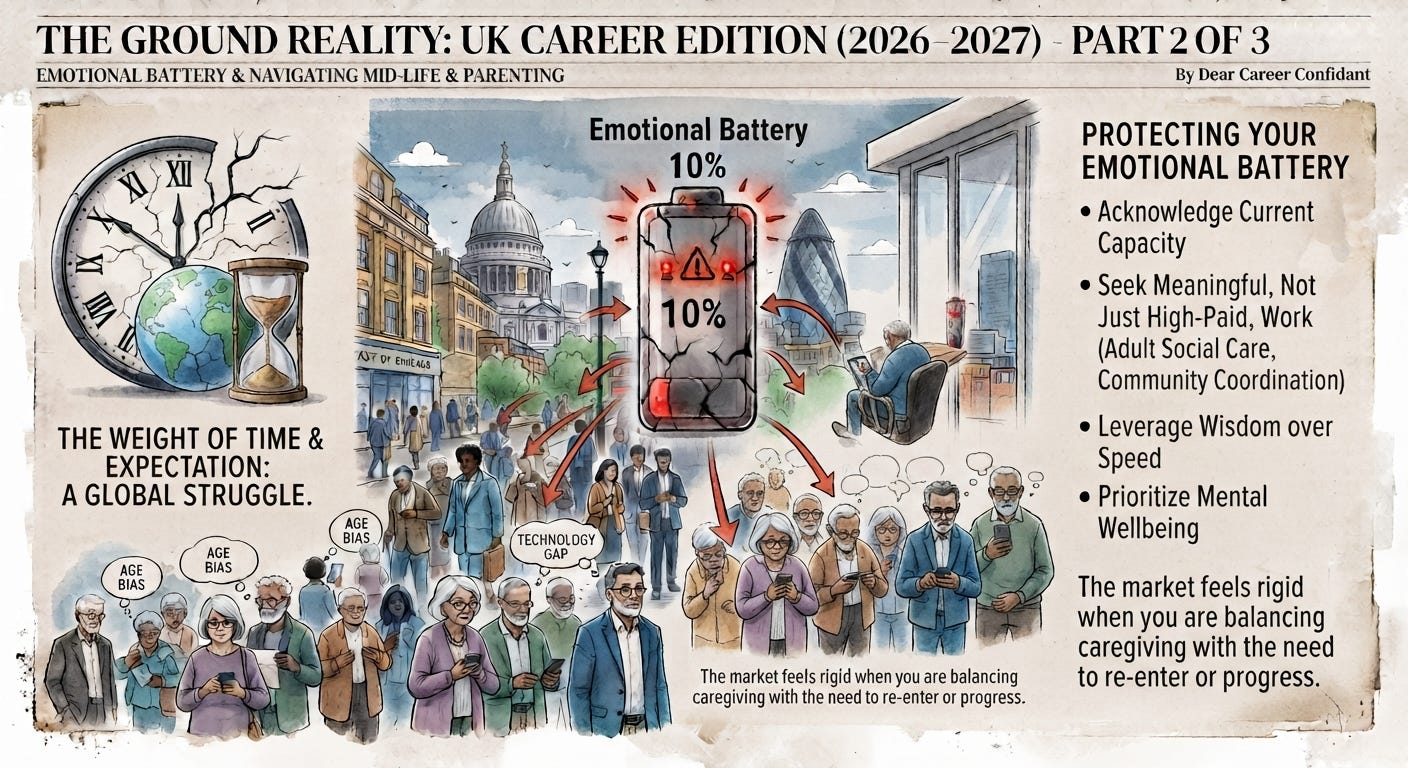
Mid-Life & Parents: Balancing career progression with childcare, eldercare, or returning to work after a break. The market can feel rigid when people desperately need flexible, hybrid, or part-time hours.
Over-50s & Career Changers: Facing age bias or feeling left behind by rapid technological shifts, all while carrying heavy personal life commitments.
Protecting Your “Emotional Battery”
One of the most vital pieces of advice I give as a career adviser—and as someone who has navigated mental health breakdowns myself—is about protecting your emotional energy.
I’ve worked on the frontline in public-facing roles where the public is stressed, angry, or in distress. If you are dealing with burnout, trauma, or hidden disabilities, your emotional battery might be sitting at 10%.
If your emotional battery is low: Avoid high-stress, low-paid, emotionally demanding public-facing roles (like customer complaints or high-concession roles). Instead, look at back-office admin, digital support, data entry, or logistics planning where you can earn a living without draining your remaining reserves.
If you have high emotional resilience: For people in their 40s, 50s, or 60s who have raised families or cared for loved ones and want meaningful human work, sectors like adult social care, community coordination, and healthcare management offer high demand, stability, and deep fulfillment.
The Bottom Line
When your emotional reserves are depleted, job hunting feels like running uphill in heavy boots. Acknowledge where your energy is right now, protect your mental health fiercely, and target roles that match your capacity rather than burning yourself out on unrealistic application volumes.
Read the Next Parts in This Series:
Read Part 1: Is the UK Job Market Broken? (A Career Adviser’s Honest Take)
Uncover the truth behind social media panic, supply and demand, and the reality facing jobseekers today.
Read Part 3: Basic Skills UK Employers Want More Than a Degree
Discover where real-world job demand exists across the UK today and the 4 practical, everyday capabilities that actually get you hired.