

For as long as I can remember, I have been fascinated by people.
Not in a superficial way.
I have always wanted to understand what makes people think the way they do, why some people are open to different perspectives, and why others seem determined to defend their own.
The older I get, the more I realise that many of life’s challenges—whether in our families, friendships, workplaces, or relationships—come down to one thing:
The human need to feel understood.
Not agreed with.
Not praised.
Not validated.
Simply understood.
Growing Up and Looking for Answers
Like many people, I grew up believing that if I explained myself clearly enough, people would understand. Life taught me that communication is rarely that simple.
People hear our words through the lens of their own experiences:
Their upbringing
Their fears
Their insecurities
Their beliefs
Their past
Two people can hear the exact same sentence and walk away with completely different interpretations.
For years, I found this frustrating. I often felt as though people were responding to a version of what I had said rather than what I had actually meant.
Over time, I started noticing that this pattern appeared everywhere. In families, workplaces, friendships, communities, and increasingly, online.
The Difference Between Listening and Reacting
One thing I have learned is that there is a huge difference between listening and reacting.
Listening is:
“That’s interesting. Tell me more.”
Reacting is:
“That doesn’t match my experience, so it must be wrong.”
One creates understanding. The other creates division.
Many of us have become so focused on responding that we forget to understand. We hear something that challenges our view of the world, and instead of becoming curious, we become defensive. The conversation changes from exploration to self-protection. The goal stops being understanding and becomes being right.
Why Being Misunderstood Hurts So Much (The Reality of C-PTSD)
For those of us who have experienced trauma, difficult relationships, or invisible challenges, being misunderstood can feel particularly painful.
Living with C-PTSD has taught me that being misunderstood isn’t always about the conversation itself. Sometimes it touches something much deeper—a lifetime of feeling unheard, overlooked, dismissed, judged, or expected to explain ourselves over and over again.
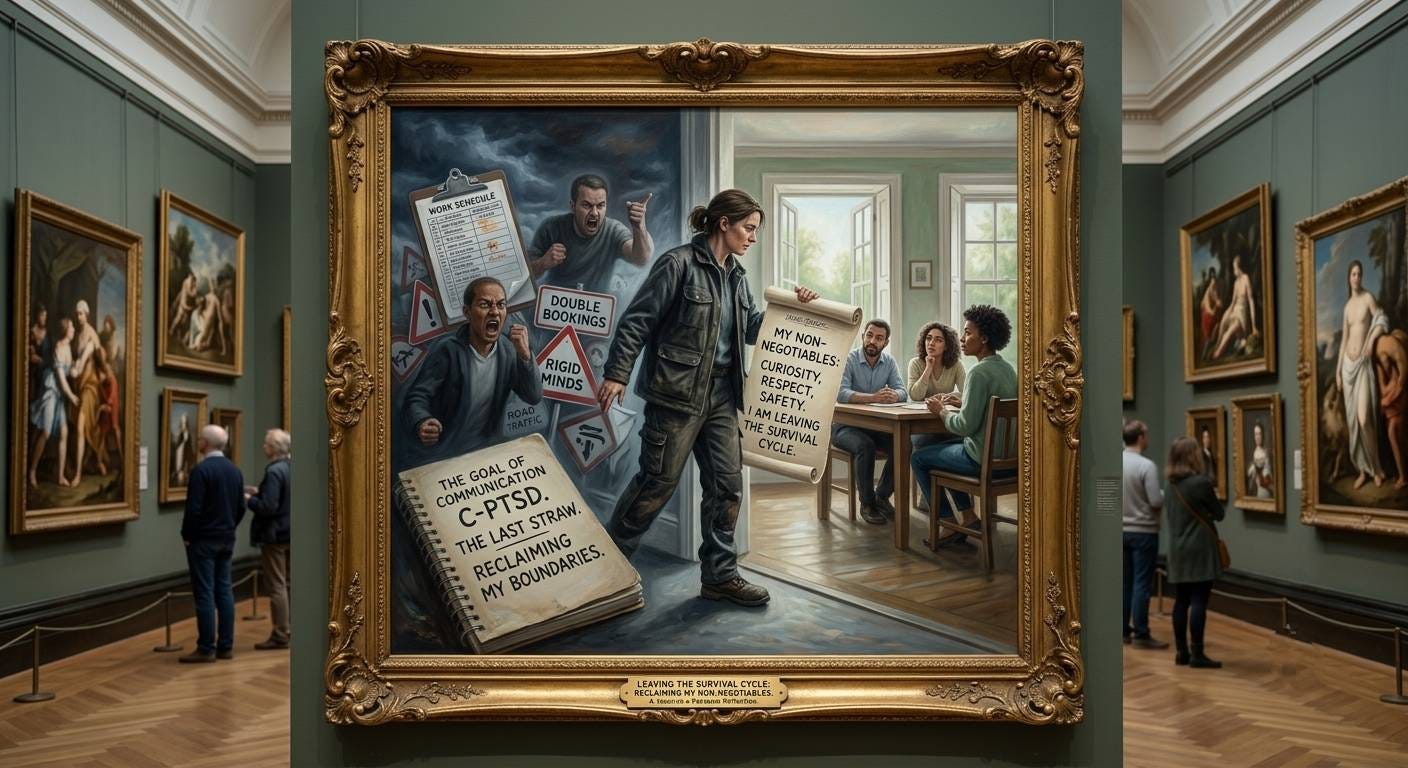
My C-PTSD stems directly from these exact issues: dealing repeatedly with closed-minded people, rigid mindsets, and environments lacking empathy. What many people don’t realise is that those experiences accumulate.
When you have faced a lifetime of dealing with people who refuse to see beyond their own perspective, a single instance of negative feedback, back-to-back demands, or systemic pressure can feel like the absolute last straw.
Eventually, you’re not simply reacting to one conversation. You’re reacting to years of trying to be understood by people who are structurally incapable of doing so.
The True Cost of Closed Mindsets: Psychological Pain
Why do we need to understand? Too often, people simply don’t want to. They think looking deeper than what they believe is “right” somehow threatens them. But true understanding doesn’t require agreement; it requires looking past our own certainties, respecting that everyone is different, and trying to live in peace whether we agree or not.
When people refuse to understand, they choose to violate others’ boundaries just to get what they want. The consequences of this are devastating. It creates deep hurt, profound pain, trauma, and severe mental damage.
Psychological and emotional trauma is the worst type of pain. It leaves no physical scars, yet it lives with a person forever. It destroys lives, erodes well-being, and violates fundamental human rights.
We must remember a simple truth: we don’t own people. We do not have the right to control them or reshape them in our image. Every single person standing in front of us is someone’s son or daughter. Their life, their thoughts, and their dignity matter—even if closed-minded people act as though they don’t.
Family: Our First Lessons in Communication
Families are often where we first learn how communication works. Some families encourage questions; others encourage compliance. Some make space for different perspectives; others struggle with disagreement.
Most of us carry those lessons into adulthood. We learn what feels safe. We learn what feels threatening. We learn whether our voice matters. And without realising it, we often repeat those patterns in our friendships, workplaces, and relationships.
This is why two adults can experience the same conversation completely differently. One hears curiosity; another hears criticism. One hears feedback; another hears rejection. Neither is necessarily wrong. They are simply hearing through different lenses.
The Workplace Is a Mirror of Human Nature
People often think workplace issues are about job titles, policies, or organisational structures. In reality, many workplace challenges are simply human challenges in a professional setting.
The need to feel respected. The need to be heard. The need to feel valued. The need to belong.
Recently, after a grueling 24 hours of heavy schedules, back-to-back bookings, double bookings, and navigating chaotic roads, I received feedback that felt entirely unfair and deeply personal. It was emotionally draining. It is exhausting to feel like you are doing your absolute best, only to be met with a rigid mindset that lacks accountability.
Some of the most productive colleagues I have worked with weren’t the ones who always agreed with me. They were the ones who asked thoughtful questions. The people who said:
“What are you seeing that I’m not seeing?”
Those conversations create growth. They create learning. They create trust. Because when people feel heard, they become more willing to hear others.
What Qualifications Can’t Teach
As I’ve grown older, I have become less impressed by titles, status, and credentials. Education, experience, and professional expertise are valuable, but there are some qualities that cannot be measured by qualifications alone:
Curiosity
Empathy
Self-awareness
Emotional intelligence
Humility
The willingness to change your mind
I’ve met highly educated people who were completely closed to new ideas. I’ve met people with few formal qualifications who possessed extraordinary wisdom. The difference was rarely intelligence; the difference was mindset.
Curiosity Is the Trait I Admire Most
If there is one trait I value above all others, it is curiosity.
Curious people are not afraid of being wrong. They understand that learning requires uncertainty. They are not afraid to ask questions, explore ideas, and admit they don’t know everything. They don’t see disagreement as a threat; they see it as an opportunity to learn.
The most influential people in my life have shared this quality. Not because they had all the answers, but because they were willing to explore the questions.
The Growth Mindset That Changed My Life
Coming from a modest background taught me something important: where you start in life does not determine how far you can grow.
Some people continuously invest in their development. They read, learn, reflect, adapt, and remain open to change. Others stop growing the moment they believe they have the answer.
What I’ve learned is that personal growth is not about intelligence. It’s about willingness. The willingness to learn, to listen, and to challenge your own assumptions.
Relationships Thrive on Understanding
Whether it’s family, friendships, partnerships, or professional relationships, understanding is what creates connection. Not agreement. Understanding.
Some of the strongest relationships I know are built between people who often disagree. The difference is that they remain curious. They don’t assume bad intentions, they don’t rush to judgement, and they seek understanding before conclusions. Those relationships feel safe, not because conflict never happens, but because people feel heard when it does.
Before We Judge Others, We Should Understand Ourselves
One of the biggest lessons I have learned is that many of our reactions to other people don’t actually begin with them. They begin with us.
Our experiences, childhood, family dynamics, past relationships, old managers, disappointments, and fears all shape our view. Every one of us views the world through a lens shaped by our own history. The challenge is that we often mistake that lens for reality. We assume our interpretation is the truth, our experience is universal, and our way is the right way.
When faced with that unfair feedback during that exhausting shift, my immediate instinct was to react with anger. But I forced myself to pause, think, and reflect:
Why did that comment trigger me?
Why did I immediately make that assumption?
Where did that belief come from?
Without reflection, we carry old wounds forward and project them onto people who have nothing to do with the original situation.
Crucially, understanding this also helps us protect ourselves. When we understand our own mind, we recognise when other people are simply projecting their own unresolved issues, anger, and lack of autonomy onto us. We can stop taking their closed-mindedness personally. Growth begins when we become aware of that process.
Letting People Live Their Own Lives
As I’ve grown older, I’ve become increasingly aware of how much energy people spend trying to change one another. Trying to convince, control, prove a point, or make others see the world exactly as they do.
Yet some of the healthiest people I know have learned a different approach. They allow people to be themselves, make choices, and walk their own path. That doesn’t mean agreeing with everything or abandoning values; it simply means recognising that every person is on their own journey.
Respect is not agreement. Respect is allowing someone else to exist without needing them to become a version of ourselves. Perhaps that is one of the greatest acts of emotional intelligence: to understand that our role is not to control other people’s lives, but to take responsibility for our own.
Because when we stop trying to change everyone around us, we create space for something much more valuable: curiosity, understanding, acceptance, connection, and ultimately, peace.
Breaking the Trend: Spotting the Survival Cycle
For a long time, I found myself in a repeating cycle. I noticed the trends in my own life: jumping from one stressful environment to another, staying in professional settings where I felt constantly unappreciated, or enduring dynamics where I was criticised rather than supported.
When you are in “survival mode,” your nervous system becomes accustomed to the chaos. You tolerate exhaustion, rigid institutions, and toxic interactions because you think that’s just how life is. You tell yourself that if you just work harder, it will be enough.
But it is never enough for environments that are structurally designed to drain you.
Recognising this trend is the first step toward freedom. If you are stuck in survival mode, wanting to leave work or life situations that keep repeating the same exhausting patterns, you have to realise that you cannot heal in the same environment that made you sick. You have to break the trend.
My Non-Negotiables: What I Need Next
To step out of survival and into true growth, I have established my non-negotiables. This is what I need next from my career, my relationships, and my environment:
Psychological Safety: I will no longer stay in spaces where my character is attacked, where my rights are ignored, or where honest communication is met with defensiveness.
Curiosity Over Certainty: I require environments—both personal and professional—where people are curious enough to ask what I mean before deciding I’ve said something wrong.
Mutual Respect and Accountability: I will not carry the weight of other people’s unresolved issues. We don’t own people, and I value spaces where individuals take responsibility for their own actions rather than dumping their pain onto others.
Supportive, Open Mindsets: I am choosing to align myself with open-minded systems and people. I am leaving behind the rigid structures that refuse to change, and stepping into spaces that value emotional intelligence, shared humanity, and human progress.
Conclusion: The Journey Back to Ourselves
As I reflect on my experiences in family life, relationships, workplaces, and my own personal growth journey, I keep coming back to the same truth: most of us are walking through life carrying stories we haven’t fully examined.
The greatest growth I have experienced has not come from learning more about other people. It has come from learning more about myself—questioning my assumptions, examining my triggers, and recognizing that self-awareness is a lifelong practice.
The older I get, the less interested I am in proving I am right. I am far more interested in understanding. Understanding myself, understanding others, and understanding why people think, feel, and behave the way they do. Because when we understand, judgement softens, defensiveness reduces, compassion grows, and relationships become healthier.
Sometimes the kindest, most powerful thing we can do is pause and remember this need.
“I want people to be curious enough to ask what I mean before deciding I’ve said something wrong.”
None of us want to be controlled, dismissed, or placed into a box created by someone else’s assumptions. We simply want the freedom to live authentically and be accepted as human beings navigating our own unique journey.
And perhaps that freedom begins when we extend the same courtesy to others, whilst holding firm boundaries to protect our own peace. To listen before judging. To understand before reacting. To question before assuming. To remain curious rather than certain.
The more we understand ourselves, the less need we have to judge others. The more we allow others to be themselves, the more freedom we give ourselves to become who we truly are.
The goal of communication isn’t to win. The goal is to understand.
Ready for 1:1 support?
The Rapid Reset Strategy Intensive is a private, 90-minute strategy reset for anyone navigating toxic workplaces, ADHD masking, burnout, or career pivots. Backed by 20+ years of corporate strategy, you’ll get immediate clarity and an exact execution blueprint.