


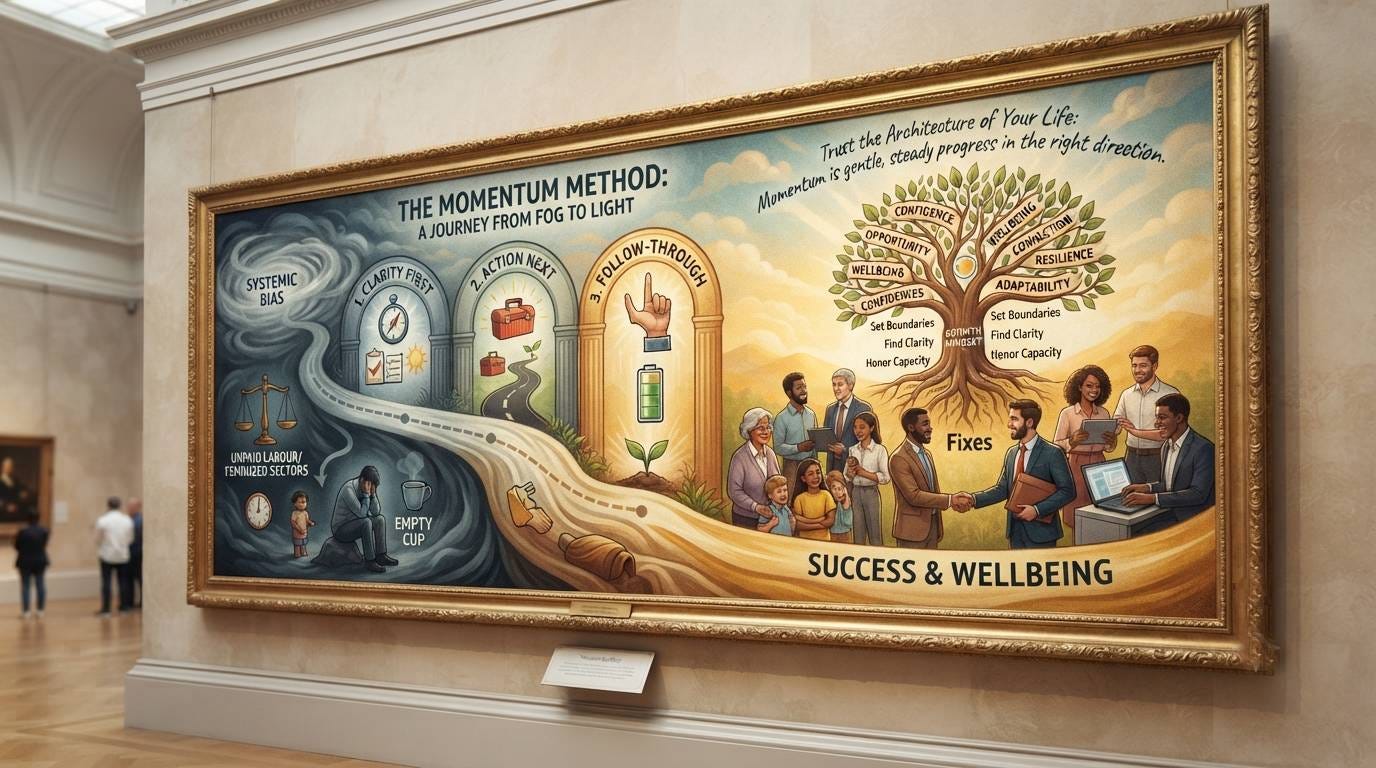
As the labour market continues to evolve, many jobseekers — especially those navigating Universal Credit, childcare responsibilities, or long gaps in employment — are feeling increasing pressure to demonstrate clarity, confidence, and adaptability. It’s completely understandable. The expectations placed on people today can feel overwhelming, and many individuals I support tell me they feel stuck, unsure, or afraid of making the “wrong” choice.
I know this from both sides of the desk. As a Level 6 qualified Careers Adviser, I have spent my career navigating the mechanics of the system. I have sat in the meetings where biased advice is given, and I have witnessed firsthand how funding cuts have crippled public services. I have worked on the front lines as a contractor, and I have seen how the system is often broken. I have looked inward at my own life—at the job I loved but eventually outgrew—and realized that the “circles” my customers were projecting onto me were often the very ones I was trapped in myself. We aren’t broken; we are human, and we are operating in a demanding system.
To help ease that pressure and provide a clear starting point, this complete toolkit is designed to help you understand your strengths, explore realistic career options, take structured action, and master the mechanics of staying in motion. This system reflects the real challenges my customers face every day — from balancing work with family life to dealing with Jobcentre expectations — and offers a practical, compassionate way forward built on three core pillars: Clarity First, Action Next, and Follow-Through.
🌱 Pillar 1: Clarity First — Understanding Your Skills & Direction
Clarity is one of the most powerful tools a jobseeker can have. When individuals understand their strengths, transferable skills, and motivations, they are better equipped to make informed decisions and present themselves confidently to employers. More importantly, clarity reduces anxiety. It helps people feel more in control of their choices, especially when external pressures feel heavy.
What Clarity Includes:
✔ A checklist for identifying strengths, personal qualities, and transferable skills
This helps you recognise what you already bring to the table — including skills gained outside traditional employment.
✔ Guidance on recognising experience gained through volunteering, caring responsibilities, hobbies, and community roles
Many people underestimate this experience, but employers value it.
✔ A career direction worksheet with reflective prompts
You’ll explore questions such as: What do I need in a job to feel comfortable and happy? What kind of environment do I thrive in? What motivates me? What am I good at that I enjoy doing? What are my long‑term aspirations?
Practical Actions:
The Reality of “Feminized” Sectors: Data shows that industries like healthcare and education are among the most emotionally taxing, yet they remain primary destinations for women, many of whom are also managing the unpaid labour of childcare and eldercare. It is no wonder so many feel drained—your cup is being emptied at work and at home. Recognising this as a systemic burden, rather than a personal failure, is a key part of finding clarity.
Completing the National Careers Service Skills Assessment.
Writing a “Career Direction Statement” — a simple summary of what you want, what you’re good at, and what matters most to you. For many people, especially parents and carers, this clarity becomes a grounding point when navigating conversations with Work Coaches or considering flexible roles.
This isn’t about choosing a job today. It’s about understanding yourself so you can make decisions that feel right for your life.
🎯 Pillar 2: Action Next — Your Practical, Pressure‑Free Career Plan
Once clarity is established, the next step is structured action — not rushing, not pressure, but steady, achievable progress. This section provides a step‑by‑step plan to help jobseekers move forward with confidence, even if they’re juggling childcare, health issues, or uncertainty about the future.
🌟 Your Go‑To Career Action Plan
✔ Reflective questions to identify what is not working in a current role
You’ll explore: What drains your energy, what skills you’re not using, what values aren’t being met, and how happy you feel in your current or previous roles. This helps you understand what to avoid — just as important as knowing what to aim for.
✔ Exercises to uncover strengths, interests, and motivations
You’ll identify what you’re naturally good at, what activities make you lose track of time, what topics you enjoy learning about, and what problems you like solving. This is where confidence begins to grow.
✔ Upskilling: Your Gateway to Opportunity
Many people on Universal Credit feel stuck because they think they don’t have the “right” skills. But free, flexible, government‑funded courses can change that — and they’re designed for people exactly in your situation. Links to: Free Courses in England, The Skills Network, National Careers Service – Find a Course.
The Growth Mindset: I see many people, including those 50+, who feel left behind by tech. You don’t need to be an expert, but a “growth mindset” is the most important skill you can own. I tell my clients: try something for fun. Whether it’s a hobby project or watching a video on a topic you like, there is no harm in seeing what is out there. Curiosity is the antidote to fear—Just Do It!
✔ Your Step‑by‑Step Action Plan: Research career paths that fit your needs, identify any skill gaps, choose one free online course, dedicate 30–60 minutes a day to learning, connect with people in your desired field, start browsing job boards, and review your plan every 2–4 weeks. This is about progress, not perfection.
🏗️ Pillar 3: Follow‑Through — Overcoming Jobseeker Burnout
Every time you try to change your life, your momentum breaks in one of six places. Once you know which one is breaking, you stop blaming yourself and start navigating with clarity. Follow‑Through is not about discipline. It’s not about forcing yourself to “push through.” It’s about understanding the mechanics of your own life — your patterns, your nervous system, your emotional triggers, your boundaries, your capacity — and learning how to repair the exact point where things fall apart.
🛑 The Six Breakpoints of Life Momentum
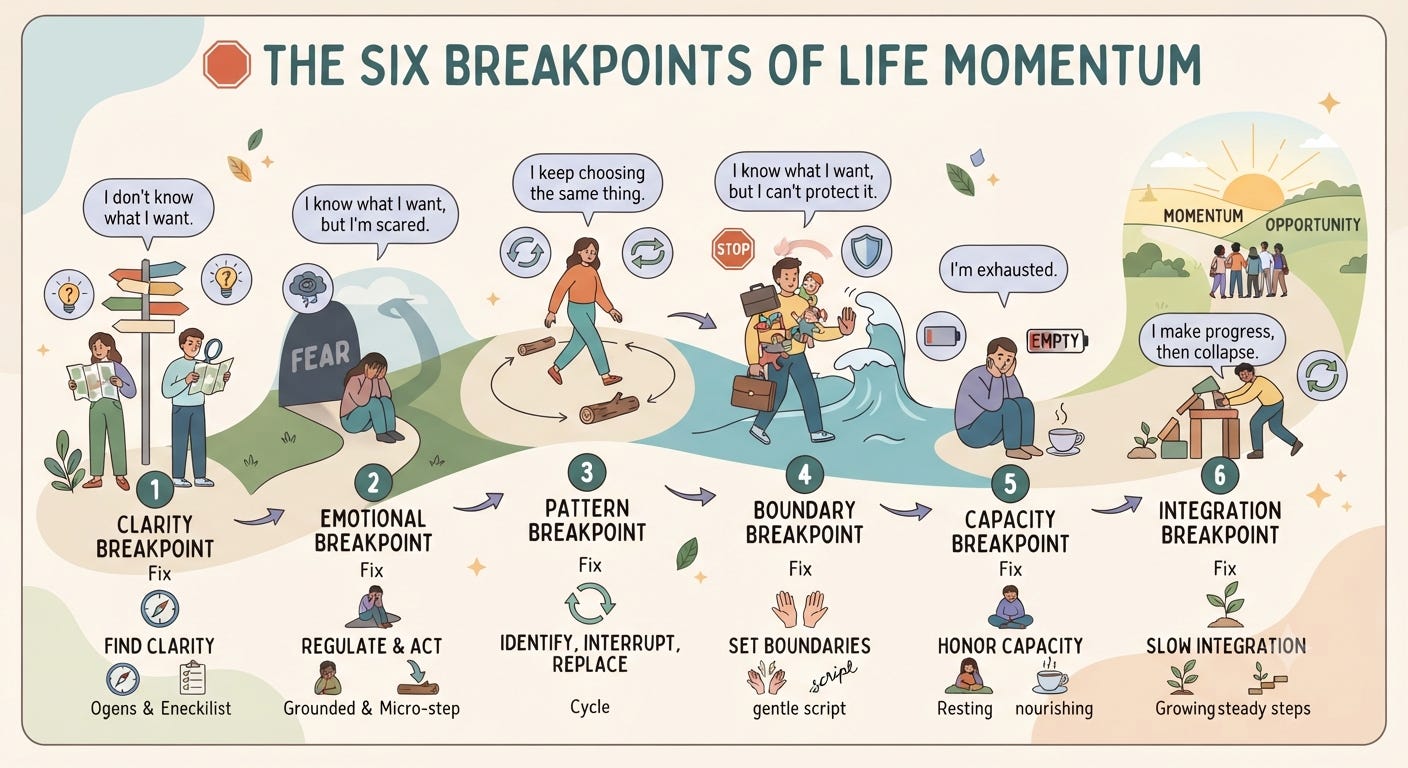
Clarity Breakpoint — “I don’t know what I want.”
Fix: Return to Clarity First. Revisit your needs, values, and strengths.
Emotional Breakpoint — “I know what I want, but I’m scared.”
Fix: Regulate before you act. Slow down, ground yourself, and take micro‑steps.
Pattern Breakpoint — “I keep choosing the same thing.”
Fix: Identify ➔ Interrupt ➔ Replace. Name the pattern, interrupt it with awareness, and replace it with a tiny, healthier micro‑choice.
Boundary Breakpoint — “I know what I want, but I can’t protect it.”
Fix: One boundary at a time. Use simple scripts: “I need time to think,” or “That doesn’t work for me.”
Capacity Breakpoint — “I’m exhausted.”
Fix: Reduce load, not goals. Remove one draining habit, add one nourishing habit, and rest without guilt. Capacity is not a moral issue.
Integration Breakpoint — “I make progress, then collapse.”
Fix: Slow integration. Repeat small wins and let your nervous system catch up. Growth is cyclical, not linear.
🎯 Supporting Jobseekers Through Change
This toolkit is designed to empower individuals at any stage of their career journey. Many people I support feel pressure from Universal Credit or worry about making the wrong decision. This toolkit helps shift the focus back to what truly matters: your strengths, your needs, your non‑negotiables, and your long‑term wellbeing.
I use my expertise to see the angles others miss. You are overqualified for the struggles you endure, and your experience—whether in the public sector or managing your own life—is a credential of resilience. By developing clarity and taking consistent steps — even small ones — jobseekers can: Build confidence, strengthen their employability, explore roles that genuinely fit their life, and move toward opportunities aligned with their strengths and aspirations.
The transformation is a process of movement. It acknowledges that while you might start in the “thorns” of a difficult situation, by stopping to reflect, planting small seeds of new skills, and walking a steady path, you can move into a landscape of opportunity and light. Career change doesn’t happen overnight, and it doesn’t need to. What matters is momentum — gentle, steady progress in the right direction.
🌅 The Final Takeaway: Trust the Architecture of Your Life
Transformation is a process of steady, intentional movement. It acknowledges that while you might start in the “thorns” of a difficult situation — feeling the heavy squeeze of financial pressure, system expectations, or deep personal exhaustion — you do not have to stay there.
By stopping to reflect, identifying exactly where your personal breakpoints are, planting small seeds of new skills, and walking a steady path, you can move out of the fog and into a landscape of opportunity and light. You do not need to figure out the next ten years today. You just need to figure out the next micro-step. Trust your strengths, protect your boundaries, and honor your capacity.
Which of the six breakpoints resonated most with where your momentum is at today?
Ready for 1:1 support?
The Rapid Reset Strategy Intensive is a private, 90-minute strategy reset for anyone navigating toxic workplaces, ADHD masking, burnout, or career pivots. Backed by 20+ years of corporate strategy, you’ll get immediate clarity and an exact execution blueprint.