


What Reality TV’s Obsession with “Chemistry” Teaches Us About Modern Love

Let’s be honest, reality dating shows are a glorious trainwreck. And yet, millions of us are completely, unapologetically hooked.
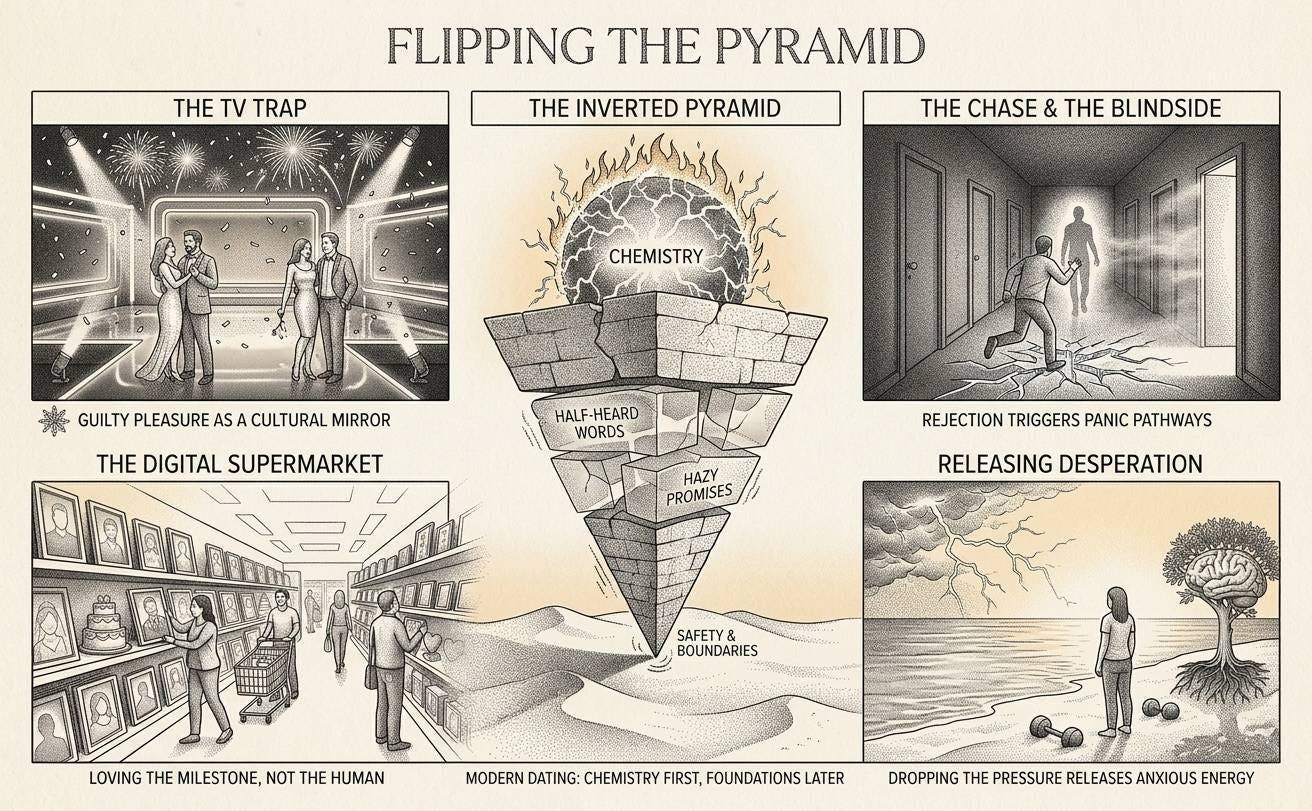
Whether it’s the high-stakes pressure cookers of Love Is Blind, the sun-drenched chaos of Love Island, or trending concepts like I Wanna Marry “Harry”, we tune in every week. But if you strip away the villa lighting, the dramatic slow-mo edits, and the producers pulling strings in the background, these shows aren’t just guilty-pleasure entertainment—they are a cultural mirror.
They reflect the exact anxieties, miscommunications, selective hearing, and flawed logic that so many of us fall into in our actual dating lives.
I don’t say this from an ivory tower looking down. I say this as someone who spent nearly twenty years searching for my person before I finally found them. I’ve lived through the desperate projections, the anxiety-driven pursuit, the ignored red flags, and the endless search for that elusive, mystical “spark.” Looking back now with a clear head, I can see where so many of us get completely lost—and why these shows capture our modern relationship blind spots so accurately.
The Illusion of Immediate “Chemistry”
Watch almost any reality dating show, and you’ll hear the word chemistry dropped every thirty seconds. But what are people actually talking about when they say “we have chemistry”?
90% of the time, they mean:
Immediate physical attraction
Surface-level banter
High-heat emotional intensity
We’ve been conditioned by media, culture, and societal standards to treat this instant spark as the holy grail. But physical attraction is inherently subjective—and deeply constructed. What one culture or era considers beautiful varies wildly. Look at historical standards in South Asian or African traditions, where fuller figures represented health, wealth, and prosperity, compared to modern Western ideals.
When couples on these shows mistake immediate physical heat for fundamental compatibility, the dynamic usually crumbles the moment real life enters the room.
Flipping Maslow’s Hierarchy of Needs
In psychology, Abraham Maslow mapped out human needs as a pyramid. At the absolute foundation—the ground floor—you have safety, security, and emotional stability. Only when those foundational bricks are solidly laid can you build upward toward deeper emotional connection, shared values, and intimacy.
Modern dating culture—amplified by reality television—has completely inverted this pyramid.
 MODERN DATING (THE INVERTED PYRAMID TRAP):
 \---------------------------------/
  \                               /   Chemistry/Spark <-- (People Start Here)
   \-----------------------------/
    \                           /    Unclear Values/Selective Hearing
     \-------------------------/
      \                       /      Zero Boundaries <-- (Unstable Base)
       \---------------------/
People jump straight to the top of the pyramid, mistaking intense physical heat or flirty banter for genuine compatibility. They hope that if the physical spark is big enough, safety, trust, and mutual respect will magically construct themselves underneath.
On shows like Let’s Marry Harry, you watch this play out in real time:
The Anxious Pursuer: Contestants get consumed by the competitive environment, clinging desperately to polite phrases, hearing only what they desperately want to hear (“He told me he cared about me!”).
The Avoidant De-escalator: On the other side, partners who feel overwhelmed default to physical affection—kissing or initiating intimacy—as a shortcut to defuse tension, shut down difficult conversations, and dodge real accountability.
When fatigue and pressure hit, decision-making plummets. Instead of stepping back and setting clear boundaries (like a simple “closed-door policy” for emotional clarity), people fall into anxious or avoidant loops. They start operating like they’re trapped in a toxic job: the culture is chaotic, the boss doesn’t respect them, but they stay anyway because they’ve normalized the disrespect.
PERSPECTIVE: THE SCIENCE OF THE CHASE
Psychology shows us that rejection triggers the exact same pathways in the brain as physical pain. When someone blindsides you or suddenly pulls away, your brain doesn’t act rationally—it enters panic mode.
For years, I mistook “the chase” for love. When you grow up or exist in environments where people aren’t accountable, respectful, or emotionally available, high-friction relationships end up feeling normal. You force counseling, you beg for closure, and you cling to breadcrumbs because the thought of stepping back feels like the world is crumbling around you.
It was only when I finally stepped away and took time out that I felt an unexpected emotion: relief. I realized I hadn’t been in love with a partner; I had been addicted to trying to prove my worth to someone who was never ready to meet me halfway.
Which Role Are You Playing?
Perhaps the biggest takeaway from analyzing these shows—and from watching real-world dynamics like those highlighted in the BBC’s Couples Therapy documentary—is that many people are in love with the milestone, not the human being sitting across from them. They want the wedding, the title, the fairytale, or the validation of being “chosen.”
Online platforms and apps often treat dating like a massive supermarket—people scroll through endless options, engaging in shallow chatter, looking for the next best thing without ever offering genuine emotional substance. We become people-pleasers, adapting ourselves just to be picked, starving for someone to simply ask, “How are you really doing?” without an ulterior motive.
Real, lasting relationships aren’t built on 24/7 fireworks. Long-term married couples will tell you that the true test of a relationship lies in respect, quiet communication, shared values, and clear boundaries. Respect sounds like: Speak to me kindly. Don’t shout at me. Honor my boundaries.
The “When You Least Expect It” Paradox
People love to repeat the cliché: “The right person will come along when you least expect it.”
When you’ve spent two decades actively searching, getting rejected, being blindsided, or dealing with inappropriate energy, hearing that phrase feels frustrating beyond belief. After 15 or 20 years of trying, you just want to tell people where to go with their unsolicited advice.
But looking back, there is an actual correlation—not just in love, but in life and career navigation. As a careers advisor, I’ve seen people in desperate situations trying to change jobs; when they operate out of intense desperation and heavy pressure, they rarely get anywhere because that anxious energy bleeds into everything they do. People can sense the strain and desperation.
When you finally drop the pressure and just be—not because your life is completely perfect, but because you are “okay” with where you are—everything shifts. When you stop striving, your anxious energy releases, and your presence becomes relaxed, grounded, and unforced. That relaxed state doesn’t mean you’ve given up; it means you’ve released the desperation. And ironically, that is usually the exact moment the right connection finally has room to enter.
It’s easy to sit on the couch and cringe at contestant behavior. But the real value in watching these shows comes when we use them as a mirror and ask ourselves:
Which character am I in my own dating life?
Am I the pursuer, jumping at breadcrumbs and ignoring clear red flags?
Am I the avoidant partner, using affection to dodge uncomfortable accountability?
Am I operating out of desperate anxious energy, or am I settled in myself?
Stay tuned for Part 2, where we break down the “Driving Without a License” metaphor, the Traffic Light Journaling System, the Alone Detox, and how to define your Green flags before you start looking for “The One.”
Ready for 1:1 support?
The Relationship Reset is a private, 90-minute strategy session for anyone navigating modern dating burnout, repeating unhealthy partner patterns, or trying to break free from anxious-avoidant loops. Backed by real-world insight and years of navigating the chaos, you’ll get immediate clarity and an exact personal action blueprint.