


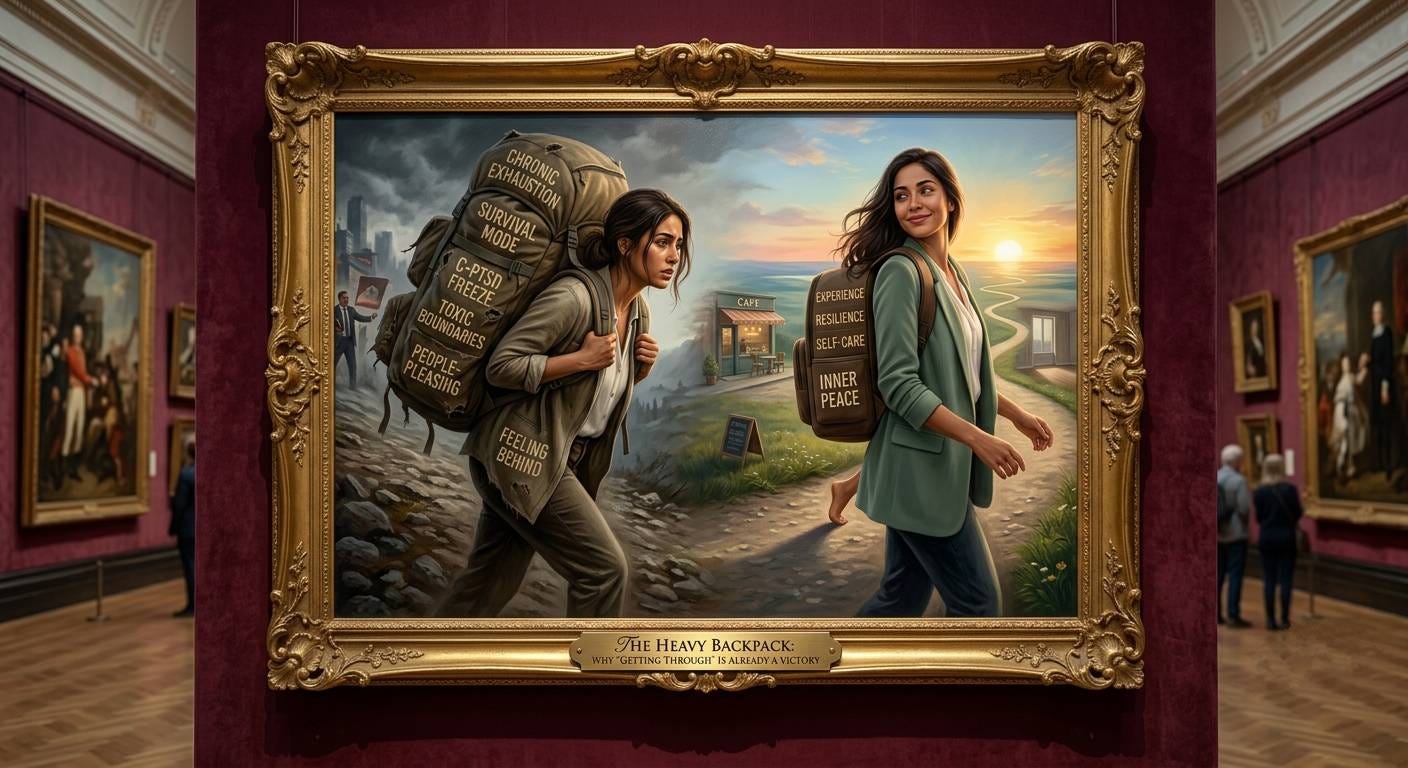
I used to find myself sitting in the dark late at night, typing questions like these into a search bar:
Why do I feel so far behind everyone else at 30?
How do I pull myself out of survival mode and C-PTSD freeze?
Is £28k a year okay if it means I finally get some peace of mind?
How to stop people-pleasing strict family members...
Why am I completely exhausted even on days I do nothing?
If any of those hit home, you might feel confused and lost, wondering how everyone else seems to have it all together.
Truth is, they don’t.
You might still feel like a failure deep down, but most people haven’t got a clue what you’ve actually been dragging around. What I’ve come to realize is that we haven’t just been living normal lives—we’ve been trying to run a full marathon carrying a massive, heavy backpack filled with weight other people were never asked to touch.
For years, I thought I was falling behind because I wasn’t climbing some corporate ladder, pulling in six figures, or finding a good partner. I didn’t realize that my nervous system was already working two full-time shifts every single day just keeping me safe.
Learning to Play Without a Coach
A few months ago, a heavy realization hit me out of nowhere: I never actually had the foundations everyone else took for granted.
No basic emotional support. No real encouragement. No safe place to land when things went wrong.
Expecting myself to effortlessly navigate adulting, work, and relationships was like expecting a kid to become a professional footballer when they were never even allowed onto the pitch.
Picture being that kid. You dream of playing, but instead of getting coached, you aren’t even allowed to kick the ball. And on the rare occasion you do make it out there, you just get shouted at and picked apart by people who don’t even know how to play the game themselves—yet act like expert referees.
When you grow up like that, you don’t learn strategy, rules, or confidence. You just learn how to dodge the shouting.
Most people enter adulthood with a solid foundation beneath them. Those of us raised in chaos had to figure out how to lay the bricks while simultaneously trying to play the game of life. We weren’t just learning how to succeed—we were having to unlearn every false, toxic rule forced onto us by people who never knew how to guide us in the first place.
Living in “Survival Mode”
When you grow up in a high-pressure, unpredictable home, your brain gets wired for constant fight-or-flight. You become hyper-vigilant. You learn to scan every room you walk into, constantly trying to predict which version of someone is about to walk through the door.
Entering adulthood doesn’t feel like stepping into freedom—it just feels like the storm is following you. Toxic bosses, loud environments, and pushy family members feel normal because your body is literally tuned for survival.
I still remember being 18, sitting in a car with my foot visibly shaking on the pedal. It wasn’t just about driving an unsafe car—it was about control. My siblings didn’t want me going out. They tried to keep my world as small as possible using suspicion, fear, and shame. Taking that wheel was my very first taste of independence, but my whole body was terrified.
For years after, that shaking foot stayed with me. Every single time I tried to claim my independence, set a firm boundary, or build something of my own, that exact same panic would surge back. My brain had been trained to think that freedom equaled danger.
Is it any surprise we struggle to “excel” or “reach our potential” in our twenties and thirties? It is physically impossible to build a dream life when 100% of your energy is going toward surviving the day without falling apart.
The “Freeze” State and the Myth of Being “Behind”
When you live with neurodivergence, C-PTSD, or hidden disabilities, trauma doesn’t always look like running around panicked—a lot of the time, it looks like Freeze.
It looks like standing right in front of a wall of potential, feeling completely paralyzed, and then spending the rest of the day tearing yourself up for not moving. We watch people our age buy houses, get promotions, start families, and we ask ourselves, “What on earth is wrong with me?”
Nothing is wrong with you. You were in survival mode.
The numbers tell the exact same story: studies show that up to 70% of people with C-PTSD experience severe executive dysfunction and chronic fatigue. When your brain is constantly scanning for threats, it locks down your ability to plan, focus, and take action.
Survival mode keeps your world small because staying safe is its only goal. You can only start building, creating, and living on your own terms when your nervous system finally figures out it’s allowed to drop its guard.
The Breaking Point: What the Science Says About Burnout
As women, we are practically taught to stretch, bend, and adapt until we break. We pull ourselves in a million directions, holding up everyone else’s needs while burying our own. We absorb all the tension, smooth over the arguments, and push through absolute exhaustion because we’ve been conditioned to think surviving is just what we do.
Until one day, you get stretched so far that something inside just snaps.
That isn’t you being weak. It’s a literal biological wall:
The Gender Gap in Anxiety: According to global health data from the World Health Organization (WHO), women are nearly twice as likely as men to be diagnosed with anxiety disorders and C-PTSD. A huge portion of this comes from handling invisible labor, family control, and societal expectations without safe emotional support.
The High Cost of Suppressed Stress: Research in somatic psychology confirms that emotional suppression doesn’t just disappear—it settles directly into your tissue. Chronic cortisol exposure over decades leads to unexplained physical symptoms, digestive issues, and severe burnout.
The Late-30s Wall: Studies on chronic stress show that long-term high cortisol levels eventually cause adrenal fatigue and nervous system depletion. What your body could somehow push through at 22 becomes physically unsustainable by 36.
When you hit that wall, your body essentially says: No more. You physically can’t run on empty anymore. The mask drops, your tolerance for toxic behavior drops to zero, and getting out becomes non-negotiable.
Earning Peace Over Status
The biggest turning point comes when you finally get it: Peace is the real wealth.
I used to judge my life by what everyone else thought I should be doing. But today, I know that making a modest living in quiet, total sensory peace is worth a million times more than making £100k while living in a house full of shouting and control.
Peace in your home: No one yelling, controlling, or making you feel small.
Peace in your work: Setting boundaries, choosing soft clients, and refusing to let anyone mistreat you for a paycheck.
Peace in your people: Surrounding yourself with individuals who calm your nervous system instead of spiking it.
Getting out of survival mode isn’t about suddenly making millions or proving anything to the world. It’s about entering your brain’s “Window of Tolerance”—that quiet space where you can sit in a café, watch the world pass by, and feel it in your bones: “The storm is over. I’m safe now.”
Finding Your Way Back to Yourself
Look, every single day is still a practice. Some days that old stress tries to creep back in, but every morning I pull myself out of it and remember: I actually have a life now, and I have a choice.
I make my own money. It might not always feel like a fortune, but it buys my freedom, my peace of mind, and a safe, beautiful space that is mine. I am loved just for who I am, without having to perform or pretend.
The hardest part of getting out of survival mode wasn’t just leaving—it was realising I had to ask myself questions I had never been allowed to answer before:
What actually makes me happy?
What is quietly draining the life out of me?
What do I actually want from this life?
Truth is, so many of us don’t even know. When you’ve spent decades just trying to keep the peace or survive the week, you don’t develop preferences—you just develop coping mechanisms.
Even back when I had completely lost hope, I still found myself quietly asking those questions. I didn’t have the answers yet, and I couldn’t see a clear way out, but just asking them was proof that a small, quiet part of me was still fighting.
Learning what brings you joy when you’ve never been asked is a slow, beautiful discovery. I am here, and I am me.
Dancing around my apartment, not afraid to take up space. Wearing minimal makeup, writing honestly about my raw experiences, and discovering—day by day—what truly makes me happy.
No one gets to tell me what to do anymore.
If You Are Rebuilding...
If you’re 23, 30, or 38 and feel like you’re having to restart your whole life, please remember this: You aren’t starting from scratch. You’re starting from experience.
Reframe your story: You didn’t “fail” in toxic jobs, bad relationships, or hard family setups—you survived them without a blueprint.
Check your environment: Psychologists note that up to 90% of our daily emotional baseline is influenced directly by our immediate environment and relationships. If a place makes your foot shake, it’s not where you’re meant to grow.
Protect your “Safe Money”: Making less money in a quiet, safe environment isn’t a step backward; it’s the exact foundation you need to thrive later.
Forgive yourself for the lost time: You weren’t wasting years. You were carrying a heavy backpack and teaching yourself the rules of life from scratch.
To anyone reading this who feels exhausted, stuck, or worried that they’ve missed their chance: You are doing enough. Getting through today is enough.
My greatest victory isn’t a fancy title, a massive bank balance, or validation from people who never got me anyway. My victory is that I got through.
I didn’t lose hope. I didn’t give up. And above all, I didn’t let their coldness turn me into a bitter, cruel, or entitled person. It is so easy for hurt people to pass that pain along—to hand down the shouting, the control, and the toxicity.
Choosing to stay kind, soft, and gentle after everything you’ve carried? That isn’t weak. That is pure courage.
You survived the storm. You built your own foundation. You claimed your freedom, and you kept your heart good. Now, go live in the quiet and dance in your own space.
Ready for 1:1 support?
The Rapid Reset Strategy Intensive is a private, 90-minute strategy reset for anyone navigating toxic workplaces, ADHD masking, burnout, or career pivots. Backed by 20+ years of corporate strategy, you’ll get immediate clarity and an exact execution blueprint.