



In any career, you’ll encounter a wide range of personalities. While many are a pleasure to work with, there are times when you’re faced with unprofessional, disrespectful, or even outright rude behavior. As a careers advisor, I’ve seen it firsthand—from people projecting frustrations onto my clients and colleagues trying to assert an authority they simply don’t have.
When I received this email, it really struck a chord. It’s a topic we often shy away from, but it’s time we talked about it.
Dear Career Confidant,
I’m a professional who prides myself on manners and curiosity. Lately, I feel like a target for everyone’s bad day. I’ve had work coaches shout at me and project their stress onto my desk. I’ve had colleagues—who aren’t even my managers—try to “discipline” me for being a minute late (even though I work independently!), all while they’ve forgotten their own paperwork and expect me to do the legwork. Even the security guard at the Job Centre is trying to “tell us off” like we’re school children while I’m trying to help a client!
I used to go above and beyond, but I’m tired of my “nice” being mistaken for a lack of backbone. How do I stop the bullying without losing my own professional cool?
— Done With the Drama
It’s a misconception that being a “nice” or helpful person means you have to tolerate bad behavior. In my experience, being nice and being professional are two different things. Professionalism is about maintaining a level of respect, integrity, and competence in your work. It’s about getting the job done well, not about catering to someone’s lack of preparation or poor attitude.
Why Do People Act This Way?
The reasons for unprofessional conduct are varied and often complex. Some individuals might be under immense stress, leading them to lash out. Others may lack proper training in communication or management. In some cases, it can be a genuine power play—an attempt to intimidate or bully you into doing what they want. It’s also important to recognize that workplace culture plays a huge role. In some organisations, particularly smaller ones or startups, there may be a lack of formal training or clear hierarchical structures, which can lead to a more chaotic and sometimes toxic environment.
Regardless of the reason, it’s not your responsibility to fix someone else’s behavior. Your primary goal is to protect your professional space and mental health.
How to Set Boundaries and Take Back Your Power
Setting boundaries isn’t about being rude; it’s about defining your limits and enforcing them professionally. Here are a few strategies I’ve found effective:
Use Direct, “One-Liner” Statements: When someone is being disrespectful, don’t engage in a long debate. A brief, firm statement can be incredibly powerful. For example:
“I don’t appreciate your tone.”
“That’s not an appropriate way to speak to a colleague.”
“I’m not your manager, and I won’t be taking orders from you.”
“My private business has nothing to do with this work, let’s stick to the matter at hand.”
Redirect and Disengage: If a colleague is demanding that you do something that isn’t your responsibility, redirect them to the correct person or department. “I think you need to speak with your manager about this,” or “My manager would be the best person to handle this.” This not only sets a boundary but also places the responsibility back where it belongs.
Keep it Professional and Impersonal: When dealing with colleagues who are trying to intimidate you, maintain your composure. Don’t let their unprofessionalism drag you down to their level. Stick to the facts, communicate what you can or can’t do, and avoid getting emotional. Your professional conduct is your greatest asset and a clear signal that you won’t be pushed around.
Know When to Involve Management: If the behavior escalates or becomes a pattern of harassment or bullying, it’s time to document it and speak to your own manager. A professional manager should support you and address the issue directly with the other party. You have a right to a respectful and safe work environment.
Re-evaluate Your Generosity: Some people may mistake your helpful nature for a lack of boundaries. While it’s great to be a team player, you don’t need to go above and beyond for those who don’t respect you. As the saying goes, “your generosity should match their respect.” Stick to your job description and the core tasks you’re responsible for.
By implementing these strategies, you can take control of the situation and reduce the impact of toxic colleagues on your professional life. Your well-being and professional integrity are worth protecting.
It takes time. Trust me, I know this did not happen overnight. I am in my late 30s and it has taken me over 25 years in my personal and professional life to learn this!
The Management Gap: Why Startups and Public Sectors Feel Like Different Planets
In my entry above, I talked about setting boundaries with toxic colleagues. But a question I often get—and something I’ve observed deeply in my career—is why the disrespect looks so different depending on where you work.
If you’ve moved between the public sector (like the Job Centre) and the private world of startups, you’ve likely felt the “Management Gap.” It’s the difference between a system that is stressed by bureaucracy and one that is toxic by design.
The Public Sector: Stressed Systems vs. Stressed People
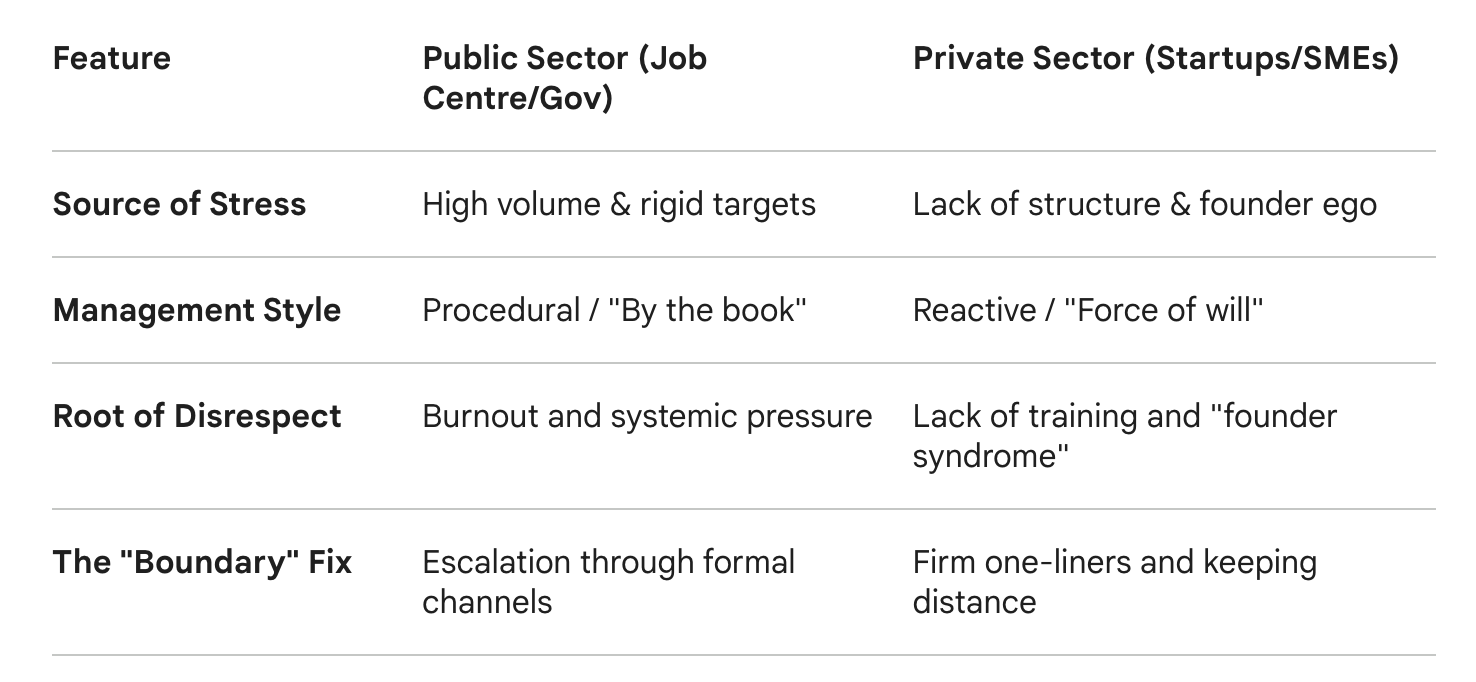
In the public sector, the rudeness often stems from projection. You see work coaches shouting or security guards overstepping because they are cogs in a massive, high-pressure machine. When the system is rigid and the volume of customers is high, people lose their “nurturing” side and default to “controlling” behavior.
The Vibe: High-stakes, high-stress, and often depersonalized.
The Conflict: People treat colleagues like “problems to be managed” rather than teammates.
The Startup Wild West: The “Accidental Manager”
In the private sector—specifically small businesses and startups—the toxicity is different. Here, you often find the Accidental Manager. This is a CEO or founder who is brilliant at their product but has zero training in leading human beings.
They don’t know how to nurture; they only know how to force. Because there is no HR department or formal hierarchy to check their behavior, their personal stress becomes the office’s weather. If they are having a bad day, everyone is.
Public vs. Private: A Snapshot
Why “Nice” Isn’t Enough in Either World
Whether you’re dealing with a public sector colleague making you “run around” because they were lazy, or a startup CEO publically humiliating you to assert power, the root is the same: A lack of leadership education.
In startups, they “force” because they don’t know how to “influence.” In the public sector, they “shout” because they feel unheard by the system.
The Confidante’s Final Word
Understanding why these people are failing to lead doesn’t mean you have to accept their behavior. In fact, understanding the gap makes it easier to keep your distance. You realize their rudeness isn’t about your performance—it’s a symptom of their own lack of skill.
As I’ve learned over 25 years: Don’t take a system’s failure personally. Do your job, keep your manners, and keep your distance from those who haven’t done the work to be professional.
Ready for 1:1 support?
The Rapid Reset Strategy Intensive is a private, 90-minute strategy reset for anyone navigating toxic workplaces, ADHD masking, burnout, or career pivots. Backed by 20+ years of corporate strategy, you’ll get immediate clarity and an exact execution blueprint.
What’s Included:
Pre-Session Audit: Reviewed in advance so we dive straight in.
90-Minute Strategy Session: Unpack patterns, build boundary scripts, or map your exit.
Bespoke Action Blueprint: Delivered to your inbox within 24–48 hours.