


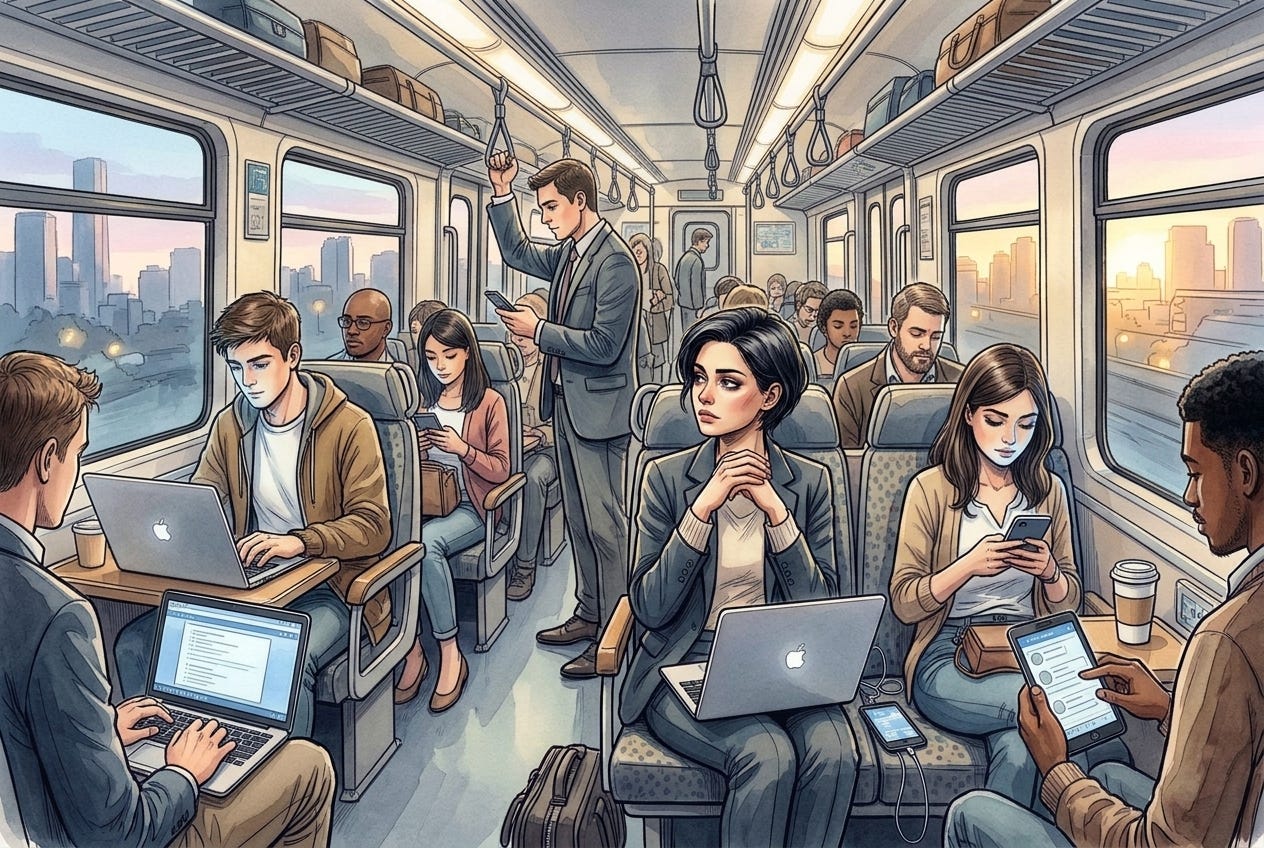
It is 10:14am. Around me in the carriage, there is a steady rhythm of morning travel—the soft clink of ceramic coffee cups, the gentle clatter of laptop keyboards, the quiet taps on glowing tablets.
Outside the window, towns and cities of the UK slide by under heavy, grey skies. Rain droplets streak down the glass, racing one another backward as the train speeds along. I rest my head slightly against the frame and wonder where everyone is going. What are their lives like when they step off this train? What do they do? What do they earn? I see white collared shirts, corporate lanyards, and luggage packed for the airport stop. Every person is carrying a story, whether visible or hidden.
My own morning started long before this train pulled out. I managed to get out of the house by 9:10am—a real victory—yet my railcard discount didn’t kick in until 10:00am. Just my luck!
To make matters harder, this was my very first day stepping out for a work task in a long time, after an extended period of medical leave and working from home. When you’re still recovering and getting your strength back, even getting out the door takes a massive effort. I started walking toward the station, but then the rain poured down. My partner was right there beside me, holding the umbrella high and doing his absolute best to shield me from the downpour while we waited for the bus. It was a lovely, caring gesture, but once the cold and wet set in, my nervous system was already on high alert. I couldn cut or shake the heavy feeling of frustration, knowing deep down that I was at the very start of a long, demanding day. Rain and physical discomfort make managing C-PTSD and sensory overload so much harder.
Rather than letting that frustration completely hijack my morning, I turned the wait at the station into an optimizing move. I found the station facilities, dried off a bit, and grabbed a quick sandwich: brown bread, chicken salad.
It isn’t my usual habit to buy food on the go, but navigating life with ADHD and C-PTSD means learning to plan for energy crashes before they hit. Rushing around in the wet drains my battery twice as fast as people realize. I woke up early, and even though I didn’t actually need to rush to catch the 9:42 train, I am glad I did. Leaving early gave me the one thing money can’t buy on a high-stress day: time to sit, regulate my nervous system, and think.
Who Gets to Take Up Space?
Then came the airport stop, and with it, a sharp reminder of how we navigate public space.
A man hauled a huge, heavy bag onto the carriage, fresh off a flight. Without looking or pausing, he slammed it directly into the corner of a woman’s laptop. No apology. No “excuse me.” No acknowledging the impact at all.
Instantly, the woman in front of me and I reacted the way many women—especially those who carry trauma—have been conditioned to react: we minded our own business and shrank back into our seats. We made ourselves smaller so as not to cause a scene.
Watching the interaction, a quiet realization hit me: A man wouldn’t accept this. A man in that situation likely wouldn’t have just shrunk back; he would have glared, cleared his throat, or explicitly called out the intrusion. Across the aisle, a man squashed behind his tablet glanced over. He caught my eye for a fraction of a second. He knew what he’d just avoided, choosing to press himself further into his seat rather than risk confrontational energy from the man next to us.
It was an off-peak train to central London—a short 25-minute journey—so we endured it. I choose to travel off-peak to save money with my third-off discount. This was a one-off work task, I operate on a low income, and I refuse to pay £6 extra when I don’t have to. I had already braved the rain and taken the bus to the station, taking every practical shortcut available to conserve my physical and emotional reserves.
Holding Space: The Power of a Gentle Check-In
Later in the day, my journey brought me into a very different kind of space: a one-on-one check-in with a colleague.
In my own life, every time I have been deeply hurt or overwhelmed without a safety net, I crashed. It shouldn’t take a complete physical or emotional collapse for people to notice that someone is drowning, but in our fast-paced world, it so often does. Looking at my colleague, I could see the telltale signs of burnout and quiet exhaustion. She was running on empty—worse off than I was.
I spoke to her with genuine care and lived understanding: take heed.
I encouraged her to tell her family she was working and step away for a moment of true rest. I understood the invisible guilt pulling at her, but living with C-PTSD has taught me a vital lesson: sometimes, doing what is best for your own sanity is the only way to survive. You have to put your own oxygen mask on first before you can help anyone else, just like they teach you on an aeroplane.
I pointed her toward accessible resources—her GP and the internal workplace mental health support. I encouraged her to share what she was going through at work without having to expose or justify her private family life, preserving her personal boundaries. She was so caught up in looking after everyone else that she was completely blind to how much of her own spirit she was giving away.
Knowing that both family pressures and workload were weighing heavily on her, I kept the entry point gentle. I asked: “Is family okay?”
She nodded quietly.
I gave her an immediate out: “Don’t worry, you don’t need to talk about that if you don’t want to. But I am here to help with work. What can work do to support you right now?”
That small, boundary-respecting question opened a door she could actually step through without feeling cornered or exposed.
As we talked, a sense of safety settled over both of us. The conversation felt like a hug in a mug—warm, comforting, and restorative. Sometimes, we don’t need a formal intervention; we just need a peer or a stranger who listens without judgment, validates our reality, and truly understands what it means to carry a heavy load.
Lessons for the Journey
Offer Low-Barrier Support: When checking in on someone, offer a clear boundary. Asking “What can work do to help?” gives them a practical door to open without forcing them to disclose personal trauma or family distress.
Notice When You Shrink: We are conditioned to make ourselves smaller when others take up inappropriate amounts of space. Simply noticing when you pull inward is the first step toward reclaiming your boundary.
Put Your Oxygen Mask on First: Protecting your energy and taking rest before a collapse is an act of necessity, not selfishness. You cannot pour support into others from an empty cup.
Boundaries Are Protective, Not Hostile: You never owe anyone—whether a stranger on a train or a manager at work—your whole story to deserve respect, quiet, or support.
Connection Heals Isolation: Finding moments of authentic peer support—that hug in a mug connection—reminds us that we do not have to navigate recovery, neurodivergence, or life’s daily pressures alone.
A Final Thought for You
Learning to navigate life with C-PTSD and ADHD isn’t about getting everything right—it’s about learning to treat yourself with grace when the world feels overwhelming. Every time you honor your energy, protect your peace, or step back instead of over-explaining, you are reclaiming a piece of your ground.
You don’t have to carry the whole load at once, and you don’t owe anyone an explanation for taking care of yourself.
As you move through your week, ask yourself:
What is one small boundary or gentle action you can put in place for yourself this week to protect your energy before you run out?
May you give yourself the space, rest, and kindness you so freely offer to others.