


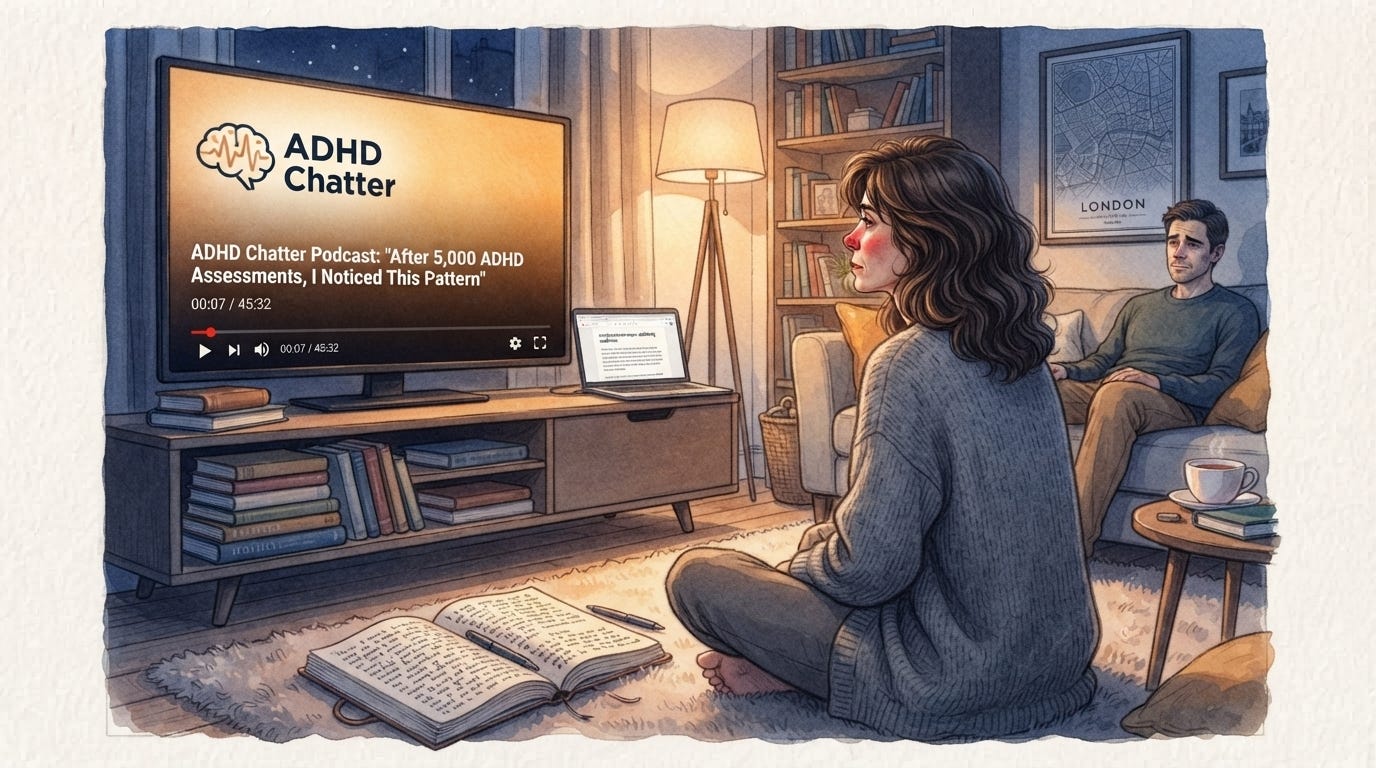
I’m tired. I’m always tired. But I’m restless too, even at bedtime, when my body should switch off and my head won’t stop. Too many tasks, too much to do, and no way to pick one.
Today was a perfect example.
I watched a video today (ADHD Chatter Podcast, “After 5,000 ADHD Assessments, I Noticed This Pattern”). In the first seven minutes, the speaker described task overload and a frozen kind of restlessness, even at sleep time. I felt it in my chest. I’m in my late 30’s, and I think I’ve been living this my whole life.
What it looks like from the outside
At work, I hit my targets. I tried so hard to look normal. People saw the results, not the effort. Inside, my head was full of notebooks, diaries and lists.
I built businesses and worked for myself. ADHD probably pushed me into it. I did well, but never made much money, and I was always waiting for it to fail. Then I had a breakdown. And still I do more and more.
People don’t understand, because effort that happens in your head is invisible. They see what didn’t get done, not the mental juggling it took to get through the day.
Growing up
At home, nobody questioned it. We were poor, and life was chaos and last-minute panic. Dad paid the bills. Mum kept the house and clothes going and covered everything. Mum may have had ADHD too, and maybe she was masking, which is why none of us saw it. It all just looked normal. It reminds me of the chaos in the film Hanging Up.
The part nobody talks about
At home, I was told I was the problem. I was told I just needed to get a job. Nobody saw that I was already carrying more than I could hold. So I pushed harder, hit my targets, built businesses and hid how much it cost me.
ADHD online can look quirky and fun. Mine looked like shame, exhaustion and trying to prove I wasn’t the issue. The breakdown wasn’t a surprise. It was where all that hiding led.
Social media doesn’t tell you about the hard side. The ADHD Chatter Podcast is the one that did, and it’s the first time I’ve heard my real story told out loud.
What’s hard day to day
I have lots to do and no energy to do it.
I forget my partner. I’m so full of tasks that he gets what’s left, which is nothing.
Lots goes wrong.
Everything seems like a challenge, even the small things.
I’m tired and restless at the same time, and I never really switch off.
Boom and bust
I’ve always lived in a boom and bust cycle. I push and push, then crash, and even in the crash I can’t switch off.
Rejection, fawning and the gold star
I’ve held rejection for years, including rejection from my family. I’m sensitive, and it cuts deep. I based my life around it.
The video talked about fawning, and about making decisions to avoid upsetting someone, especially as women. That’s me. I always tried a bit harder to get the gold star. I got on with it, because that was easier than being the one who upset anyone.
Something different is hard. Change throws me.
Giving too much, no boundaries
I gave so much of myself to jobs that weren’t worth it. I didn’t know how to say no. Boundaries were something I struggled with, and I paid for it in energy I didn’t have.
At work I was told to look at myself. My manager has ADHD, but I don’t think she truly understood. ADHD looks different in different people, and having it doesn’t mean you can see what someone else is carrying.
Grieving and worrying
I’m grieving my childhood self, the little girl who was coping with no map and no one seeing it. And I worry about my future self. Both are true at once.
What I’ve learned so far
Tired and wired is a real combination. When the brain never switches off, you can be wiped out and restless at the same time. Poor sleep, stress and trauma can feed the same loop, not only ADHD.
Overload leads to freezing. Too many tasks makes it hard to pick one, so nothing gets started.
ADHD and trauma overlap a lot. They can look alike and both can be true. I know I have trauma from work and from childhood, and I think ADHD is here too.
Masking hides it. Women, and especially BAME women, are often missed or diagnosed late because ADHD can look like anxiety, stress or trauma when someone is working hard to cope.
High masking costs energy. Doing well while waiting for it to fail is a heavy way to live, and it may be part of why I’m always tired.
My Partner
By the end of the day I have nothing left for him. That isn’t because I don’t love him. Something short I could say: “I’m not pulling away from you. I’m running on empty, and I want to find a way to reconnect.”
Most days still feel like a loop: the frantic push to get everything done, followed by the inevitable crash where my body says enough and shuts down. If you live in that same boom-and-bust cycle, you know how heavy it feels. You push through the exhaustion, hit your marks, and then pay the price in energy you don’t actually have.
What happens to us? We burn out. We carry invisible weight, mask until we’re empty, and spend years shaping ourselves to avoid the sting of rejection.
What can we do? We can stop hiding. We can trade the exhaustion of perfection for the messy, unglamorous truth of healing. We can drop the mask, set a 10-minute timer for a brain dump, and finally give ourselves permission to be human.
That is why I am sharing this. I am going to journal my journey online—not because I have it all figured out, but because I am done editing myself to keep everyone else comfortable.
No longer afraid of being rejected. This is me.
We aren’t broken. We were just surviving without a map. But piece by piece, as we share our stories out loud, we are finally drawing one.
What helps right now
A messy brain dump: set a 10-minute timer and write whatever comes, no structure. Sort it later or never.
Keep writing here. I already think in notebooks and diaries.
Next steps
Get a formal assessment, ideally with someone who understands masking, trauma and cultural context, so they can sort out what’s what.
Take this piece along as a list of examples for the assessor.
Paste the video transcript (Description, then Show transcript) if I want a closer breakdown of the first seven minutes.
To end on
I’m not broken. I’ve been coping with no map, and I’m only now starting to see the shape of it.
ADHD isn’t always the child who can’t sit still. Sometimes it’s the person who hits every target and collapses at home.