


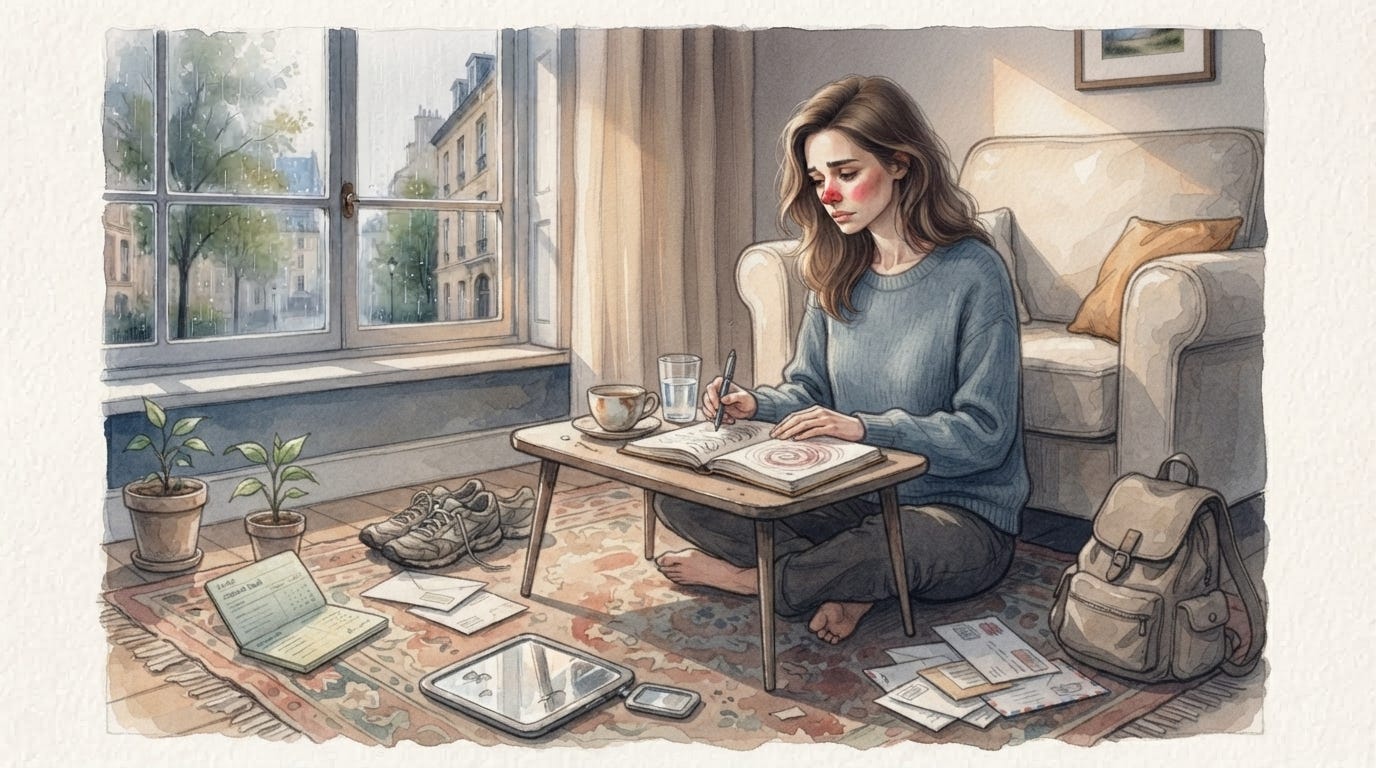
I spent most of my life believing I was the problem.
Growing up, when I struggled, I wasn’t met with comfort — I was met with being told off. When I reached for connection, even something as simple as friendship, it was shut down. When I needed emotional support, there was none. What I got instead was control: do as you’re told, or face anger, silence, or being ignored. I learned early that having needs was dangerous. That wanting things — love, attention, to be heard — made me the difficult one, not the people who weren’t giving it.
Looking back now, in my late thirties, I can see clearly: I wasn’t a naughty child. I was a child who wanted to be loved, accepted, heard, and seen. That’s it. That’s all it ever was.
My family’s story about our childhood is a different one. In their version, everything was fine — my parents were doing their best under pressure, and whatever happened wasn’t really anything. Some of my siblings have never questioned that version. They don’t look back, because looking back isn’t necessary when the story you’ve been told is already comfortable. I understand why. It’s easier. But it isn’t my experience, and for a long time, I doubted my own memory because no one else in my family saw what I saw.
I also noticed, without having language for it until recently, that it wasn’t equal. My older brother was supported differently. My eldest sister still carries her own version of events, one that doesn’t match mine. I’m not interested in competing over whose pain is worse, or assigning blame like a scoreboard. I’m interested in being honest about what actually happened to me, because without that honesty, I can’t understand why I am the way I am now.
The Pattern That Followed Me
What I didn’t understand until very recently is that this childhood pattern didn’t stay in childhood. It became the blueprint for everything.
At work, I shrank. I let people who were far less capable than me speak over me, dismiss me, and make me feel small — because somewhere underneath, I still believed that having needs, taking up space, or pushing back would cost me something. I gave everything to employers and colleagues and kept nothing for myself, the same way I gave compliance to survive as a child.
Financially, I stayed low. Despite running businesses, being featured in national media, advising people professionally for years — I kept ending up in low-income situations, unable to picture a future further than a few months ahead. I genuinely could not see further forward than three months at a time, for most of my adult life. That’s not laziness or lack of ambition. That’s a nervous system that was never taught it was safe to hope for more, because hoping as a child had only ever led to disappointment.
By my late twenties and through my thirties, it caught up with me. Two breakdowns. Periods of serious illness. Months spent unable to function, sofa-bound, just trying to survive day to day while still working to pay bills I could barely afford. From the outside, people might look at that and wonder why someone so capable kept struggling so much. From the inside, I now understand exactly why.
The Revelation
The piece that finally made sense of all of it came down to one idea: disconnection.
As a child, when I needed help and no one came — not once, but over and over — I didn’t just learn to stop asking. Something deeper happened. I learned to stop feeling how much I wanted it. Wanting love and not receiving it hurt. Needing support and getting nothing back hurt more each time. So, to survive, I muted it. Not consciously. My mind did what it needed to do to protect a child who had nowhere else to put that pain: it turned the want down low enough that it stopped being unbearable.
That muting kept me alive and functioning as a child with no real emotional support. But the same muting followed me into adulthood, and it’s been running quietly in the background ever since — in every job where I accepted disrespect, every year I didn’t ask for the pay or the role I was worth, every relationship where I gave and gave and expected nothing back, because somewhere inside me, nothing coming back was simply what I had learned to expect.
I do the same thing with ordinary things now, without even realising it — I give to my car, my home, my work, and nothing comes back, and I’ve accepted that as normal, the same way I once accepted getting nothing back as a child.
Seeing supported versus unsupported laid out plainly — that was the moment it all clicked. I wasn’t failing to cope. I was coping exactly as well as someone could, given what I was never given.
What I’m Not Saying
I want to be clear about something, because it matters to me: this isn’t about playing the victim, and it isn’t about punishing my family for not having it worse than they did. I know we weren’t in a warzone. I know my parents were likely struggling themselves, in ways I may never fully understand. I’m not interested in a blame contest.
What I am saying is this: not seeing the reality of what happened doesn’t make it not have happened. And not naming it doesn’t make its effects disappear. My family’s standard of “we did enough” and my actual lived experience of what I received are two different things, and both of those things can be true without one of them being an attack on the other. Acknowledging a low standard isn’t the same as hating the people who set it.
In my family specifically, the men learned to switch off emotion, and it’s worked for them — they thrive financially, unbothered. The women in my family — my mother, my sister, and me — never learned that same trick. We feel it. We carry it.
Enough is enough. I’m done accepting a version of events that doesn’t match what I lived through, just to keep the peace.
Moving Forward
I spent most of my thirties looking for answers without knowing that’s what I was doing. Two breakdowns, chronic illness, poverty, isolation — all of it eventually led me here, to finally understanding the thread that ties it all together: a child who wasn’t allowed to need anything, who grew into an adult who still doesn’t quite believe she’s allowed to need anything either.
Understanding it doesn’t undo the years. But it changes what happens next.
If you recognise yourself in any of this — the shrinking, the over-giving, the quiet belief that your needs are somehow too much — I want you to know that noticing it is not weakness. It’s the beginning of change. You learned to survive by muting yourself. You can learn, slowly and safely, to turn that volume back up.
My promise to myself:
I am done muting my own needs to keep others comfortable. I am done accepting disrespect because some version of me, somewhere underneath, still believes I haven’t earned the right to expect better. My health is not negotiable. My needs are not an inconvenience. I am not the problem I was told I was.
I am thirty-six years old, and for the first time, I am choosing myself first — not because I stopped caring about anyone else, but because I finally understand that caring for myself was never actually optional. It was just the one thing no one ever taught me how to do.
Enough is enough. I choose me now.