


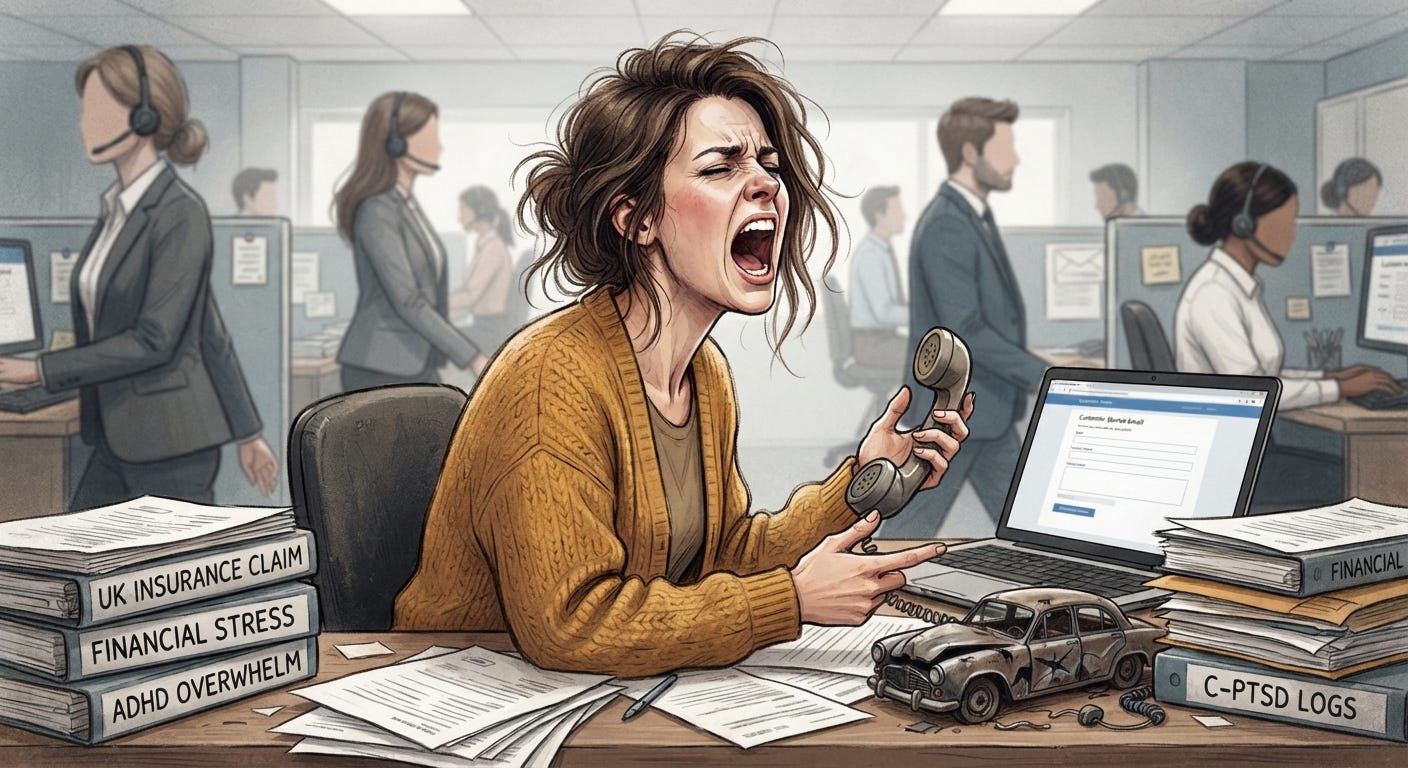
It started with a free hour I hadn’t planned on.
A few work meetings had been cancelled, and a webinar I’d been in finished early. That left a gap in my day, and I knew exactly what it was for: the call I’d been dreading.
The webinar hadn’t been easy. My attention drifted and I felt myself nodding off. I kept thinking about how it could have been run better, and how much I could have used the support of a wellbeing team that day. Something in it stirred up old feelings, and I carried them with me afterwards. With ADHD and CPTSD, one hard moment doesn’t stay in its box. It spills into the next.
The call was on my mind the whole time. Admiral closes in the evening, and this was the only window I had before work got busy again. Just before I dialled, an email arrived saying I’d get an update in 7 to 10 days. I’d been waiting for a phone call, a voice, someone to tell me what was happening. Instead I got another message saying, in effect, wait longer.
So I called anyway.
The background
For nearly three months I’ve been without my car. It was a non-fault accident: someone hit me from behind and admitted responsibility, and my insurer has the evidence. The car has since been classed as a total loss, and the offer is around £1,000. I’ve owned it for over 20 years. It’s a high-quality classic with one previous owner and very low mileage, and I have every service record. Similar cars are listed online for £1,500 to £1,700.
On paper, this is an insurance claim. In real life, it’s something else.
I use my car for shopping, appointments, seeing people and getting to exercise. I have a chronic illness and back pain. Since the accident my health has gone downhill, because the things that help me get better are the things I can’t do. Yesterday I went to London for the first time in three months and came home in pain, with stiff feet.
Two calls
The first person I spoke to seemed stressed, and I met that with patience. I kept it short and simple and asked one question: what do I do for the next two weeks? I had to say three times that I have hidden disabilities before it registered. I was told to wait for the assessor and passed on.
I’m not criticising her as a person. Empathy fatigue is real, and I used to work on the front line. But a good handover takes ten seconds: “I’m sorry, I can’t answer this properly, so let me pass you to a colleague who can. Is that okay?” What hurts is being moved along without anyone trying.
Then I spoke to Anchal. She listened without interrupting and asked, “Can I just clarify?” When she didn’t know something, she said so and went to find out. She called me back, explained where things stood, and told me she’d raise a formal complaint on my behalf and stay on my case. She was calm for 45 minutes and kept things simple. She even told me something nobody had said before: I may be able to drive my car once the cracked plate is fixed.
Earlier on, another advisor, McDonald, asked how I’d prefer to receive information, then worked out how to avoid burying me in emails. It’s a small question that treats you as a person.
The cyclone
I’ve been patient. I waited weeks for an independent assessor. I’ve received documents that say “independent assessor” without saying what for. I’ve explained my situation again and again, and I still can’t resolve it. The same questions go round, nothing lands, and each lap takes more out of me.
Being left in the dark isn’t neutral. When nobody tells you what’s happening, your brain fills the gap, and with CPTSD it fills it with threat. I did nothing wrong, yet I’m the one chasing, explaining and waiting, while paying for insurance on a car I’ve been told I can’t drive.
I understand that companies are busy. But in a busy system, the people who get overlooked are often the most vulnerable: those with disabilities, chronic illness, or less energy to keep fighting.
What people don’t see
The call lasted about an hour. Then it took over the next three, replaying in my head while my body stayed on edge. Now it’s the evening, and I still can’t switch off. I hadn’t eaten or had a drink of water for most of the day.
This is the part nobody shares. With ADHD, a stressful task can swallow everything else, including my basic needs, and afterwards my brain won’t power down. With CPTSD, being dismissed doesn’t feel like a minor irritation. My nervous system reads it as a threat. The person on the phone sees a call that ended. I live with what comes after: the pain, the exhaustion, the skipped meals, the racing mind at night.
This isn’t new for me. Situations like this have been hard all my life, which is why clear communication matters so much.
Not everyone can just buy another car
There’s an assumption that everyone has savings or can take out finance. I don’t. I’m on a low income, I work, and most days I only just get by. I can’t buy a replacement, and the car isn’t worth scrapping. It needs a bumper and a plate, and I know how to fix it. What I need is a fair valuation.
For me, the car isn’t a luxury. It’s how I get food, get to appointments and look after my body. Public transport isn’t a realistic option: I live too far from the nearest stop, and the service isn’t reliable. Without the car, I’m stuck at home, in pain, and getting worse.
I’ve been polite and patient throughout, partly so I wouldn’t add to anyone’s stress. But being the easy customer shouldn’t mean being the one left waiting. When nobody seems to take ownership, the person with the least energy to fight is the one who gets left. Good leadership shows up in how a company treats someone who can’t shout loudest.
What I’m asking for
A payout that reflects what the car is actually worth
Clear written confirmation of whether I can drive it
A refund or credit for insurance paid on a car I couldn’t use
At the very least, regular updates and a named contact
None of this is a luxury. For someone on a low income with a disability, it decides whether I can keep going.
What’s in my control
I can’t control the accident, the cost of living, or how fast a company moves. In the UK, prices have outpaced pay for many of us, and one setback can tip everything over. I spent six years building a business that helped other people, and I know what it is to be good at supporting others while struggling to support myself. Restarting is hard.
But some things are mine:
What I put in writing: a clear complaint, my service history and the comparable listings
What I keep: receipts, call notes and reference numbers
What I ask for: a fair payout, a straight answer on driving, a premium refund
How I look after myself: eating, drinking and resting before the next call
Who I let help: the people who listen, like Anchal
I can’t fix the whole system today. I can take the next small step.
What I learned
Clear communication is an accommodation. Short, plain updates reduce overwhelm.
“Let me go and find out” beats a brush-off.
Follow-through matters more than sympathy.
Poor service is expensive. I’m paying in premiums, transport costs, lost independence and my health.
Being nice has a limit. I can stay respectful and still be firm.
Pausing works. Today I got frustrated, then stopped, took a breath and said, “I know it’s not your fault, but this is my challenge.” That took years of practice.
Next time, I’ll write my questions down beforehand, and eat and drink before I pick up the phone.
Grateful
In the middle of all this, I got to see what good looks like. Anchal, thank you. You went beyond your job. You listened, you checked, you came back, and you treated me like a person. I’m very lucky to have spoken to you, and I hope Admiral knows what it has in you.
If you’ve been stuck in a cycle like this with a company, a surgery or an employer, you’re not alone. And if you’re the person on the other end of the line, your patience may be what gets someone through the day.