


When people hear the word “skills” in the context of job hunting, they often panic. They assume they need to go back to university, pay thousands for a new diploma, or learn complex software coding from scratch.
In reality, after spending years advising both employers and jobseekers across the UK, I can tell you that most hiring managers are starving for basic, reliable human fundamentals. Market surveys from organizations like ManpowerGroup and regional skills boards emphasize that while specialized technical gaps exist, the everyday bottleneck for local employers is finding candidates with strong foundational capabilities.
Most jobseekers fail because they suffer from “inside-out” thinking: they stare entirely at their own CV, their own degree, and what the job can do for them, completely forgetting that hiring is an “outside-in” transaction. Companies do not open roles out of charity; they open roles because they have a specific operational pain point, a compliance pressure, a capacity bottleneck, or an emerging market risk.
If you want to step out of overcrowded online application queues and actually get noticed, here is where real-world demand lives and what actually works today.
Where Real-World UK Demand Actually Exists
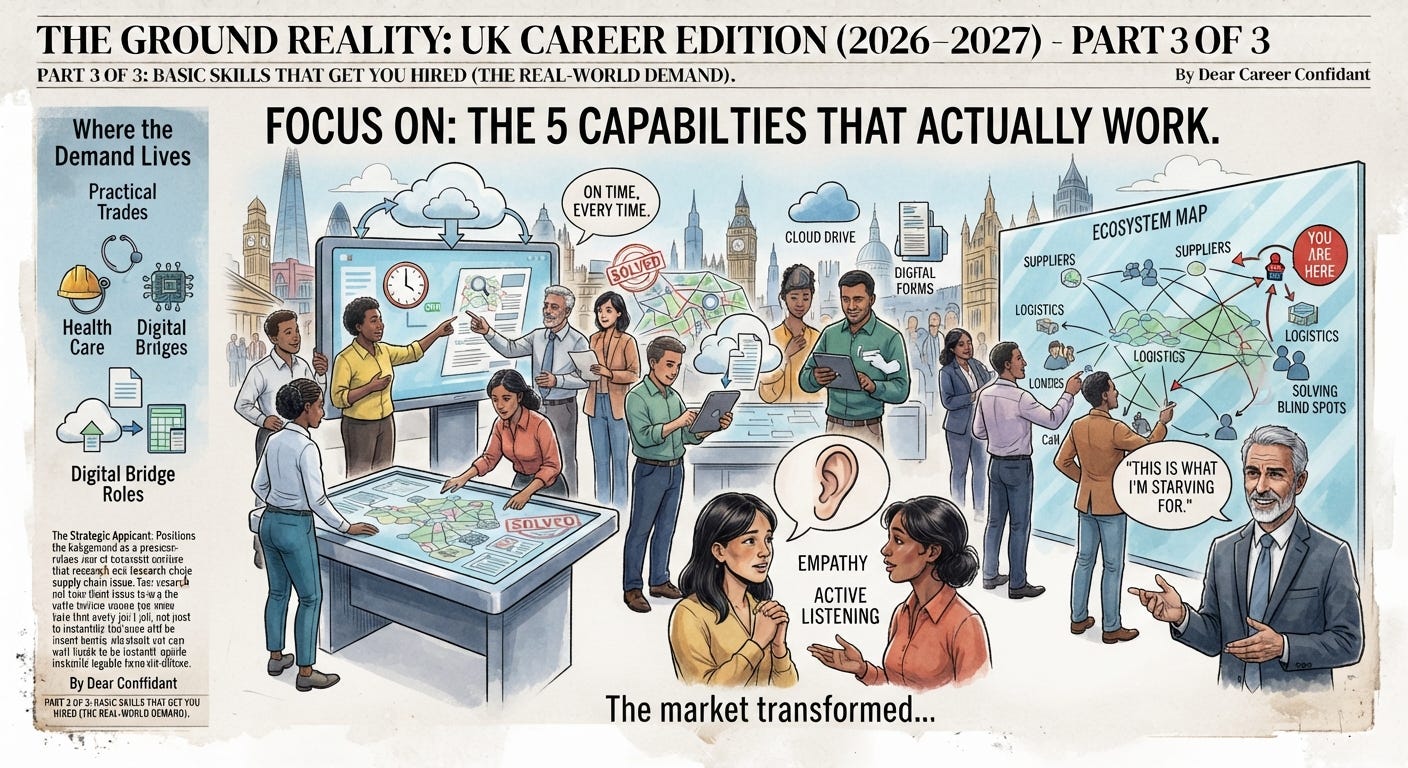
If you stop applying exclusively to the same hyper-competitive corporate graduate schemes that everyone on professional networks is fighting over, you will notice massive sectors across the UK actively recruiting talent:
Practical Skilled Trades & Green Infrastructure: Electricians, retrofitting specialists, green-energy technicians, construction supervisors, and logistics planners. With an aging workforce across the trades, local councils and private firms are seeing sustained demand and strong long-term earning potential.
Health & Social Care: An aging UK population means care coordinators, administrative support staff, and healthcare operational specialists are urgently needed in virtually every town and city across the country.
The “Digital Bridge” Roles: Companies desperately need people who can bridge everyday human work with basic technology—using simple tools like cloud-based documents, digital forms, inventory software, or basic reporting dashboards to streamline daily operations.
The 5 Capabilities That Actually Work
Moving forward effectively comes down to five essential capabilities that set you apart immediately in front of a hiring manager:
1. Demonstrate Dependability
This sounds simple, but it is remarkably rare. Show up on time, communicate clearly before deadlines slip, and take pride in being reliable. In a workplace culture where flakey communication is common, absolute dependability acts as an immediate differentiator.
2. Show Resourcefulness & Problem Solving
Instead of waiting to be handed every single answer, demonstrate that you can research solutions, troubleshoot basic administrative issues, or look things up independently before escalating a problem.
3. Build Basic Digital Confidence
You do not need to be a software developer or data scientist. Focus on mastering everyday workplace tools: navigating cloud drives, organizing digital files, using collaborative spreadsheets, and communicating professionally through digital channels.
4. Lean into Human Connection & Active Listening
Practice face-to-face communication, active listening, and genuine empathy. As workplaces introduce more automated software and AI tools, genuine human warmth, emotional intelligence, and clear spoken communication become more valuable, not less.
5. Understand the Macro Picture (Reading the Room & Solving Blind Spots)
Most jobseekers look exclusively at a job description and wonder why they aren’t getting hired. They forget that businesses operate inside a massive, shifting ecosystem shaped by external pressures.
When a hiring manager posts a vague job description or writes an article on LinkedIn complaining about falling behind on digital integration, supply chain delays, or regulatory compliance, they are broadcasting their pain:
The Average Applicant: Sends a generic CV stating, “I am a hard worker with great communication skills,” focusing entirely on themselves.
The Strategic Applicant: Reads between the lines, recognizes the company’s broader operational pressure, and positions their background as the exact pressure-release valve for that specific problem.
When you factor in this macro-awareness, you stop starting every sentence with “I want” or “My career goals are.” Instead, you ask yourself: How does my past experience protect that manager’s time, save money, or solve a blind spot they are currently struggling with?
Final Thought: Controlling What Is in Front of You
It is completely natural for your brain to lean into fear when social media feeds you bad news, or when you look at a job market that doesn’t look like it used to. Time moves on, economies evolve, and yesterday is not today.
We cannot single-handedly rewrite global economic history, but we can control how we respond to the world in front of us today.
Whether you are 18, 38, or 58, the UK job market is not dead. It has transformed. By getting honest about your skills, protecting your emotional battery, learning the digital basics, and focusing on where real-world demand lives, taking back control of your career is entirely within your reach.
Read the Rest of the Series:
Read Part 1: Is the UK Job Market Broken? (A Career Adviser’s Honest Take)
Uncover the truth behind social media panic, supply and demand, and the reality facing jobseekers today.
Read Part 2: How to Job Hunt When Your Emotional Battery Is at 10%
Explore why career shifts feel so personal, how to manage age-related workplace transitions, and how to protect your mental health while searching for work.