


It is coming up to my birthday, and whenever this time of year arrives, I always find myself stepping back to look at my life, my career, and my purpose.
Looking back, I wasn’t the “A* scholarship” student in my family. I’ve been the sibling who had the most jobs, navigated wildly different industries—from big private sector consultancies and FTSE 100 firms down to frontline civil service roles—and faced my fair share of personal struggles, mental health breakdowns, and job search stress.
Over 20 years, I’ve built my own business, trained leadership teams in digital technology, and worked on the frontline advising people across every age bracket, gender, and background—from 18-year-olds with basic GCSEs to 55-year-old career changers, PhD holders, and international migrants. Most of my work takes me across local communities in the East of England and various regions, traveling directly into communities to listen to what people are going through every single day.
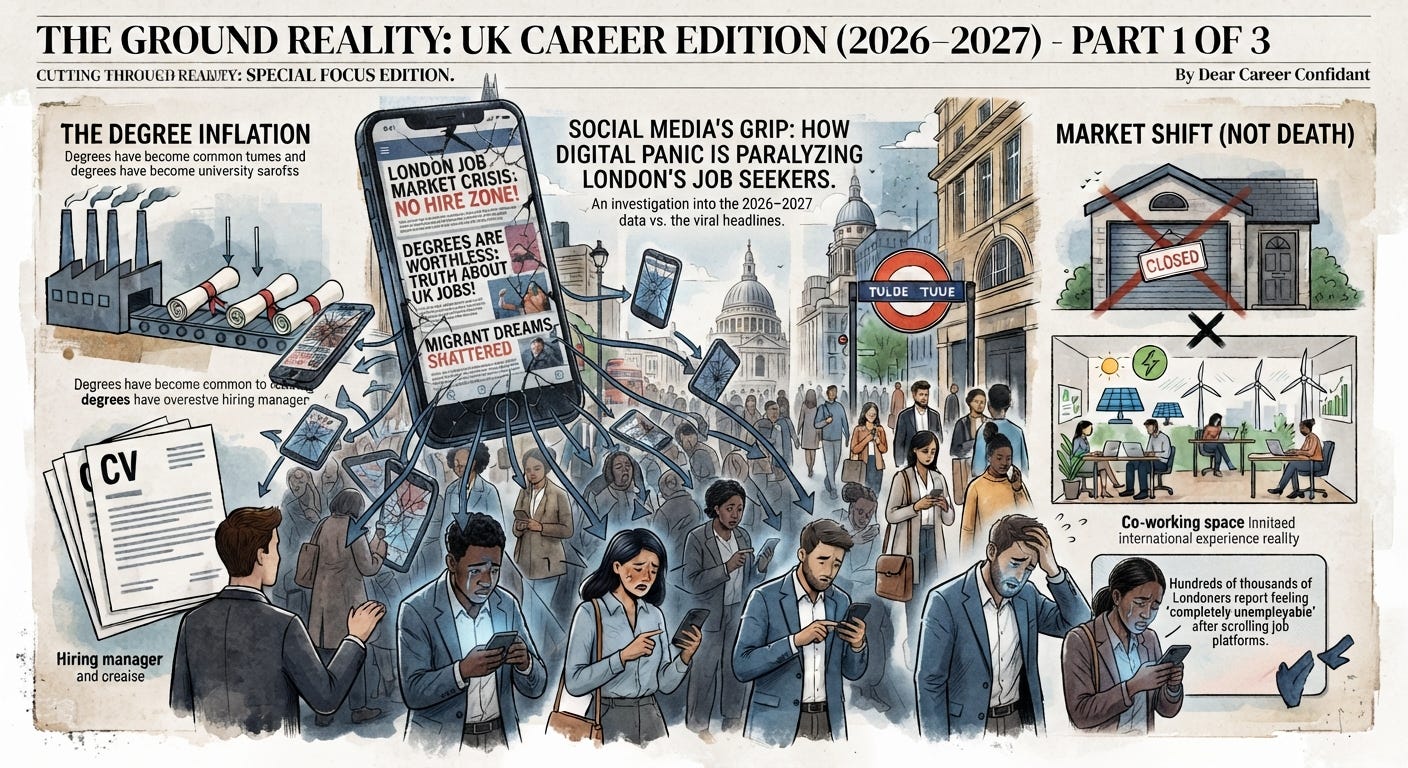
Right now, when you turn on YouTube or open social media, you see a tidal wave of content claiming the job market is completely finished and that nobody can get hired.
As someone who spends every single day looking at actual data, talking to real hiring managers, and sitting across the table from real jobseekers: It is time to stop the panic.
If we look at the official Office for National Statistics (ONS) data, the UK employment rate holds relatively steady at around 75.1%, with over 34 million people currently in work across the country. Social media runs on fear because panic gets clicks. “Everything is ruined” goes viral; “The market has simply shifted and here is how you adapt” does not. Let’s cut through the noise, drop the confusing economic jargon, and look at what is actually happening across the board.
Understanding Supply and Demand: The iPhone & Car Examples
To understand why the job market feels so tough right now, we don’t need complex economics textbooks. We just need to look at everyday items everyone understands: iPhones and cars.
1. The iPhone Example (Demand vs. Value)
When a brand-new iPhone releases and everybody wants the exact same model, the price is high and people queue around the block. But if millions of people end up carrying that exact same phone, having one is no longer unique—it becomes the baseline standard.
That is what has happened with general academic degrees. Thirty years ago, fewer than 20% of UK adults held a university degree, so having one made you stand out instantly. Today, around half of young adults enter higher education. Because the market is flooded with general qualifications, holding a degree alone no longer guarantees an automatic desk job. The supply went up, so the relative value of the paper qualification shifted.
2. The Car Example (Market Shift vs. Market Death)
Imagine you want to buy a car, but social media is screaming:
“Car dealerships are closing down! Gasoline is too expensive! Nobody is driving anymore, the market is dead!”
If you listen to that fear, you might think transportation is over. But then you step outside, look at the road, and see traffic everywhere.
Yes, traditional garages or old-school car sales models are changing, but electric vehicle technology, green energy infrastructure, repair services, and supply logistics are active. The need to move people and goods hasn’t vanished—the way we do it has simply evolved. The UK job market is identical.
The Reality of International Experiences: Debunking the “Shiny UK” Myth
When I travel abroad, people often talk about London and the UK as a crown jewel—a place where life is instantly easy. The UK is my home and I love it, but the reality on the ground for newcomers today is very different from what it was decades ago.
Lately, on platforms like TikTok and YouTube, you’ll see videos from international students and migrants—particularly from South Asia, Africa, and parts of Europe—sharing their honest accounts: “I came to the UK, and I can’t find a job in my field.”
They are not lying, and their frustration is completely real:
The Generational Shift: Decades ago, a generation came to the UK when the economy was structured differently and living costs were manageable. Today, new arrivals step into a market that is already tight.
The Visa Sponsorship Bottleneck: Many move here aiming for corporate tech or finance jobs. However, UK companies rarely offer work visa sponsorship for entry-to-mid-level corporate positions because domestic competition is high.
Unseen Family Pressure: Many migrants face immense financial pressure from families back home who believe the “UK dream” myth. Returning home feels impossible due to expectations, creating severe emotional strain.
Moving to the UK is no longer an automatic ticket to a high-paying corporate career, and acknowledging that reality is essential for fair, honest guidance.
The Bottom Line
The UK job market isn’t dead—it’s saturated in old paths and growing in new ones. In Part 2, we are going to look at why career shifts feel so personal, why over-50s are struggling with a specific hidden gap, and how to protect your mental energy while looking for work.
Read the Next Parts in This Series:
Read Part 2: How to Job Hunt When Your Emotional Battery Is at 10%
Explore why career shifts feel so personal, how to manage age-related workplace transitions, and how to protect your mental health while searching for work.
Read Part 3: Basic Skills UK Employers Want More Than a Degree
Discover where real-world job demand exists across the UK today and the 4 practical, everyday capabilities that actually get you hired.