



When most people seek help for their career, they start with the surface-level symptoms.
You find yourself staring at your laptop screen on a Sunday night, your thumb hovering over the power button, frozen by an intense, heavy dread. You struggle to pull yourself out of bed to face the morning commute. You find yourself taking five extra minutes in your car in the workplace car park just to build the nerve to walk through the front door.
When this happens, your immediate instinct is to blame yourself: “I’m just being lazy,” “I lack discipline,” or “I need to fix my time management.”
But those visible struggles are rarely the actual problem. They are merely the end result—the physical smoke signals of a fire that has been burning beneath the surface for years.
The reason I write this is simple: I spent years lost, psychologically depleted, and wondering why my income, effort, and happiness never added up to the life I knew I was capable of living. What I eventually realised was that I had allowed the hidden agendas of external systems and well-meaning people to quietly pull me off my own trajectory.
This article is not here to tell you what to do. It is not another 10-step guide, and it does not carry a hidden agenda. It is simply a different perspective—a mirror to help you look past the surface symptoms, examine real workplace scenarios, and explore the root causes of what might be holding you back.
The “I Didn’t Mean It” Blind Spot and Systemic Exploitation
In workplace culture, authority figures often benefit directly from your suffering without ever viewing themselves as malicious.
Consider a well-meaning line manager under corporate pressure. She doesn’t wake up in the morning with a secret plan to ruin your mental health. But her annual bonus, her professional reputation, and her standing with senior leadership depend entirely on your output.
She might drop “casual” comments throughout the week:
“I know it’s late, but if we don’t finish this deck tonight, the director is going to think we’re slacking.”
“I noticed you logged off right at 5:00 PM yesterday. We really need everyone going the extra mile during this quarter.”
“If we miss this target, I can’t guarantee what HR will do with team restructuring.”
These aren’t open attacks; they are subtle, persistent pokes. The implicit threat is clear: swallow your personal life, ignore your physical exhaustion, and hit the target—or face financial insecurity and job loss.
Because your manager speaks warmly and claims she “doesn’t mean to cause harm,” your natural impulse is to appease her. You work through lunch. You answer emails from your bed at 10:00 PM. You cancel plans with friends. The result is a dynamic of quiet, systemic exploitation: you bleed energy, and the institution reaps the financial reward.
When you finally break down and tell her you’re drowning, the response is rarely structural change. Instead, it is classic invalidation:
“I was only trying to push you because I see so much potential in you.”
“Everyone on the team is working late right now, not just you.”
“Are you sure you’re organised enough? Maybe we need to look at your workload management.”
This is institutional gaslighting. It reframes a broken, under-resourced, coercive workload as a personal defect in your resilience or ability to cope.
[Systemic Corporate Targets]
          │
          ▼
[Managerial Pressure & Subtle Threats] ("We need to go the extra mile")
          │
          ▼
[Fear of Job Loss & Over-Functioning] (Working through lunch, late-night emails)
          │
          ▼
[Internalised Failure & Nervous System Collapse] ("Why can't I handle this?")
The Cycle of Damage: Real-World Scenarios of How Trauma Spreads
When toxic pressure trickles down from the top, it fundamentally alters how human beings behave. People under constant threat don’t just endure stress; their core defence mechanisms shift to survive:
Scenario A: The Complete Shutdown (The Quiet Withdrawal)
Consider an employee who entered the company two years ago full of ideas and enthusiasm. After having her ideas constantly dismissed, being passed over for credit, and being reprimanded for taking initiative, she shuts down. She stops speaking up in meetings. She does the absolute minimum required to avoid being noticed. Her internal creativity, her hobbies outside of work, and her passion evaporate. She becomes a passive observer in her own career, operating purely on survival instinct.
Scenario B: The Defensive Perpetrator (Passing the Harm Down)
Consider a mid-level team lead who was brutally micro-managed when he was junior. To protect his own position, he adopts the exact tactics used against him. He watches his team’s online status indicators like a hawk, questions why someone took a 15-minute screen break, and uses aggressive or passive-aggressive remarks in team chats. He justifies it by thinking, “That’s just how the real world works—I survived it, so they have to.”
Scenario C: The Repeat Victim (Carrying the Fear)
Consider someone who leaves a hostile workplace after a painful exit. They start a new job at a company with a genuinely supportive team. Yet, every time their new manager asks for a quick 5-minute catch-up, their heart races, their stomach drops, and they assume they are about to be fired. They over-prepare, work overtime unnecessarily, and remain hyper-vigilant because their nervous system is still stuck in the previous warzone.
A Nation in Survival Mode: The UK Reality
This isn’t an isolated personal struggle; it is a structural crisis affecting millions of workers daily.
In the UK, economic strain, rising living costs, and stagnant wages have pushed a massive portion of the population into a perpetual state of nervous system dysregulation. According to data from the Health and Safety Executive (HSE), work-related stress, depression, or anxiety accounts for over 49% of all work-related ill health in Great Britain. Furthermore, Mind UK reports that 1 in 6 workers experience a common mental health problem in any given week.
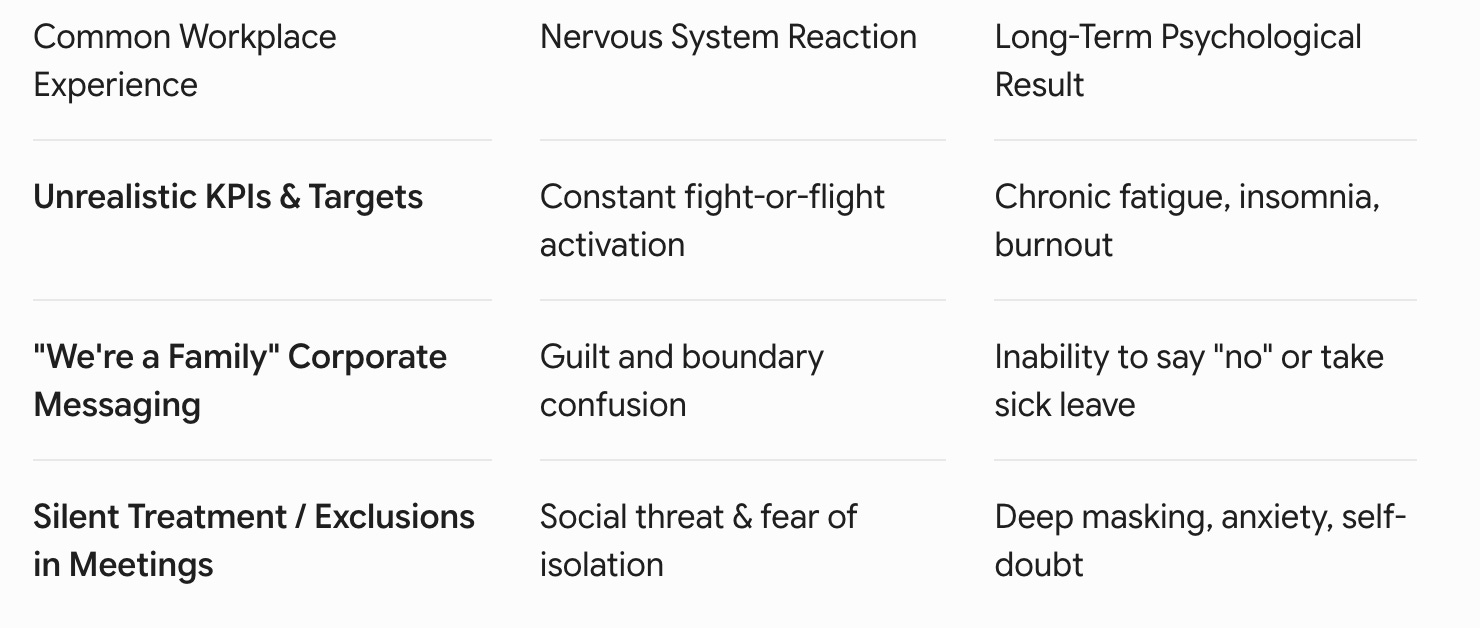
People remain silent not because they agree with the terms, but because rent, mortgages, and energy bills require a steady paycheck. When staying silent is a prerequisite for financial survival, workplaces can exploit “unintentional” harm with near-total impunity.
Gendered Expectations: The Double Burden on Women
This blind spot hits women with double force, driven by deep-seated societal conditioning and corporate norms.
Imagine a female mid-level professional in a corporate department. When project deadlines slip, she is naturally the one who steps in to organise the administrative mess, smooth over strained client relationships, and plan team morale events. None of this work is in her job description, and none of it counts towards her promotion metrics.
When a male colleague aggressively asserts his opinion in a meeting, he is praised for his “strong leadership vision.” When she firmly points out a flaw in a project plan, she receives feedback that she needs to work on her “tone” or be “more collaborative.”
Women are systematically trained to prioritise the emotional comfort of the room over their own boundaries. In the workplace, this manifests as taking on unrewarded emotional labour, covering for systemic inefficiencies, and staying quiet in the face of coercive management styles to avoid being labelled “difficult.” The result is an invisible tax on women’s health, leading to profound internal exhaustion.
The Sorting Machine: Academic Filters and Structural Invalidation
This cycle of self-doubt starts long before entering the workforce. It begins in the school system, where arbitrary metrics sort human beings into rigid categories of “capable” and “incapable.”
Think about standard corporate graduate schemes or entry-level job applications in the UK. Countless organisations set an automated filter requiring a minimum 2:1 degree classification.
If you left university with a 2:2—perhaps because you were balancing part-time jobs, dealing with family difficulties, or navigating undiagnosed ADHD—the automated recruitment software throws your application in the bin before a human ever reads it.
The message implicit in that rejection is devastating: You lack intelligence. You aren’t corporate material.
What the system’s algorithm fails to measure is emotional intelligence, practical problem-solving, resilience, real-world grit, and non-linear thinking. The academic filter isn’t built to find brilliant, adaptable human minds; it is built to find individuals who excel at conforming to standardised testing. When an ADHD or CPTSD brain attempts to force itself through that rigid filter, the friction generates immense internal shame.
An Invitation to Reflect
There are no right or wrong answers here, and there is no standard blueprint to follow. This piece is simply an offering—a space for you to pause, step back from the daily grind, and reflect on your own journey:
When you feel unable to open your laptop or face the workday, is it really because you are “lazy”—or is your body protesting an environment that feels unsafe?
Where in your professional or personal life are you accommodating someone else’s “unintentional” harm at the expense of your own physical health?
How much of your current career path was chosen by you, and how much was driven by a desire to prove your worth to a system that was never built for your brain?
You don’t need another expert telling you how to live your life. Take what resonates with your experience, leave what doesn’t, and give yourself permission to start trusting what your own mind and body have been trying to tell you all along.
Ready for 1:1 support?
The Rapid Reset Strategy Intensive is a private, 90-minute strategy reset for anyone navigating toxic workplaces, ADHD masking, burnout, or career pivots. Backed by 20+ years of corporate strategy, you’ll get immediate clarity and an exact execution blueprint.
What’s Included:
Pre-Session Audit: Reviewed in advance so we dive straight in.
90-Minute Strategy Session: Unpack patterns, build boundary scripts, or map your exit.
Bespoke Action Blueprint: Delivered to your inbox within 24–48 hours.