


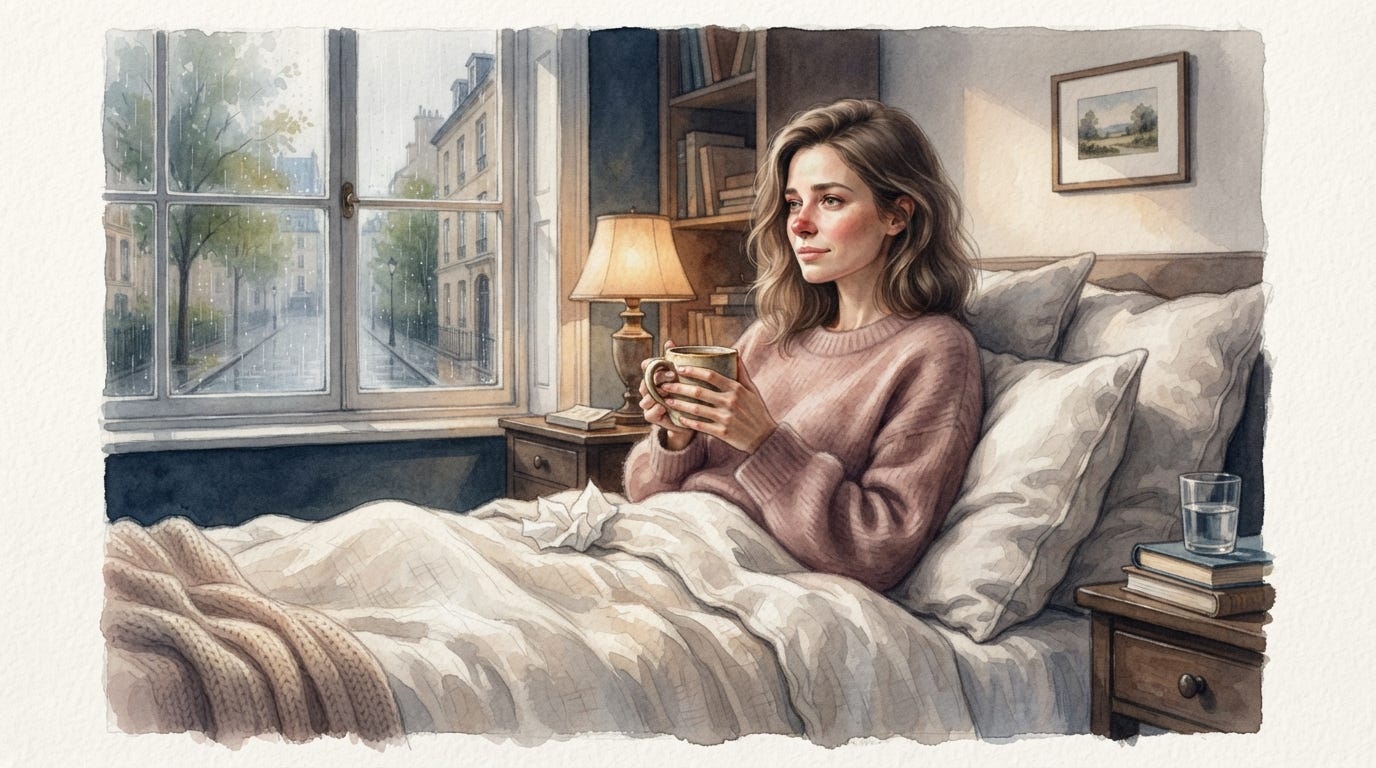
Why do you get ill the moment you finally rest? Many people report it, and researchers suggest that when long-term stress eases, your body may finally let you feel what it was holding back. Here’s my story of the armour, the let-down and the boom-bust cycle behind it, and what the research can and can’t tell us.
I’m writing this from bed again. The sniffles have dragged on for over a week, on and off. Just when I think I’ve shaken it, it comes back.
I spent my recent birthday in my late thirties bunged up, with a headache and a cup of tea going cold beside me. It looks like a rubbish way to mark a year of life. But lying awake in the middle of the night, I started to understand it. I’d also noticed something that scared me a little: I had quietly stopped giving more than I was being given.
Coming back to work
I’d just returned from medical leave. I work on the front line, sitting with people who are struggling day after day. I live with ADHD and C-PTSD, and being switched on for other people’s crises costs me more than most people see.
On my first day back, I took it easy. I didn’t worry about what any manager thought. I had a return to work to get through and counselling to get to. I worked four properly productive hours, then looked up and it was 4pm, and I was still at my desk. I could have closed off hours earlier.
The old me would have panicked. This time I felt calm, a quiet, unfamiliar “no more.”
The next day I felt worse. In the middle of the night I woke up blocked and uncomfortable, and the room wasn’t even cold. I couldn’t sleep, so I did what I always do when my brain won’t switch off: I went down a research rabbit hole.
The armour
Here’s the metaphor that made sense of it for me.
For years, my nervous system has worn armour. When you live with chronic stress, ADHD or trauma, your body learns to stay on guard. It keeps you moving through the workday, the demands and the fear of getting it wrong. You don’t notice the weight, because you’ve carried it so long it feels like part of you.
Then you finally stop. You go on leave, or you come home, or you take a breath. Your body gets the signal that it’s safe enough to unbuckle. And that’s when you feel every bruise underneath.
What the research suggests
I’m not a doctor, and I don’t want to oversell this, so here’s what I found and how far it goes.
Leisure sickness and the “let-down effect.” Many people report getting ill just when pressure eases, such as at the start of a holiday, after a deadline or on leave. Researchers call one version of this “leisure sickness.” The evidence is thin and mostly self-reported, so it isn’t proven, but plenty of people recognise it.
Stress and the immune system. Chronic stress doesn’t simply switch your immune system off. It can disrupt how it works. Cortisol also helps keep inflammation in check, so researchers suggest that when stress drops, aches, headaches and tiredness may feel louder than they did while you were pushing through.
A virus is still the most likely cause of a cold. I’m not saying relaxing gave me the sniffles. The more honest idea is that stress easing may change when, and how strongly, you feel illness. It can feel as though the body stores stress, which is a metaphor rather than a literal fact, but it matches many people’s lived experience.
Reading all this, I felt less broken and more explained.
The low-energy kitchen
Healing needs good food, but being ill leaves you with nothing left to cook it. And I’ve started to wonder how much of my low energy is down to years of not eating well. Nutrients like iron, B vitamins, magnesium and vitamin D help your body make energy and keep your nerves and immune system working. If you’ve gone years without enough of them, it’s possible your reserves have been running low, and stress, burnout or time off can be the moment it shows. I can’t say that’s what happened to me, and only a GP and a blood test can tell. But it would explain why standing at a counter to cook felt like climbing a mountain. The usual advice to “just make a healthy meal” ignores that.
So I went zero-effort. I prepped cold oats the night before. In my favourite bowl, I added coconut shavings, granola and almond flakes. The fruit in my fridge was a bit bitter, but a drizzle of honey sorted that. It isn’t a perfect wellness routine, but it feeds me without asking for energy I don’t have.
The good news is that small, low-effort choices still count. Every bowl like this is a little deposit back into an account that’s been running on overdraft for a long time.
If you suspect you’re low on something, please speak to your GP before taking supplements, and see them if your symptoms drag on for more than a week or two. Stress can change how and when we feel illness, but it’s always worth ruling out anything else.
My boom and bust
I’ve always lived in a boom-bust cycle. For as long as I can remember, I’d push hard, hit the target, say yes to everything and run on adrenaline. Then I’d crash into exhaustion, flatness and days of recovery. Then I’d do it all again.
For five or six years I’ve read every book I could find to understand why. What I learned is that there’s always more to learn, but here’s the simple version of what stuck:
ADHD brains often run on urgency and interest. Pressure can make us feel switched on and capable, so we chase it without noticing the cost. “Boom-bust” isn’t a medical term, but plenty of people with ADHD recognise it.
Trauma teaches the body to stay on guard. If you’ve lived with C-PTSD, “always on” can feel like safety, and rest can feel unsafe even when you desperately need it.
Masking is expensive. Appearing calm, capable and easy to work with takes real energy, and it gets paid for later, usually in the crash.
At work, I was the one who had everyone’s back, who stayed calm with struggling clients and never made a fuss. Then I’d go home and fall apart. Nobody saw the bust, so nobody understood the cost of the boom.
You aren’t alone if your body keeps forcing you to rest the moment you try to take a breath. It makes you look back and ask the question we are all too terrified to face: why did we accept a life built on running on empty?
Next: Part 2: Overqualified, Underpaid and Over-Giving: What Working From Fear Did to Me → That’s the other half of the story: why I stayed, what my journals showed me, and what I’m learning to do differently.