


In Part 1, I explained why my body fell apart the moment I finally stopped. This is the other half: why I stayed so long, what my journals were telling me, and what I’m learning about over-giving, burnout and boundaries.
If you haven’t read it, Part 1 is here: Why I Got Ill the Moment I Finally Stopped. It explains the armour my nervous system had been wearing. This part is about the person inside it, and about the job that kept me wearing it.
How I worked: fear, targets and being “the expert”
For a long time I worked from fear. I stayed focused on targets, did as I was told and kept my head down, even though I was the expert in the room. I’d just come through a year off unwell, I needed the money to pay the bills, and this job felt like the best I could do in this new phase of my life. So I held on.
But the longer I stayed, the worse it got on the inside. The people we support need high-level help, and carrying that day after day drained me. Some weeks I was away from home as well.
Those weeks stand out. I’d spend my days supporting people in genuine crisis while still being measured on my numbers. By the end of the week I was running on adrenaline. I hit the targets, stayed calm and told no one how I really was. At the next check-in, the conversation was about figures. Nobody asked how I was. I said “fine,” because “fine” kept me safe.
Management didn’t really get it. They weren’t unkind, but nobody was looking at what it cost me. I over-gave to keep the peace because I was scared of losing my job and scared of being “difficult.” Being reliable became a way of staying safe, and it quietly wore me down.
I got it, but I wasn’t ready to take it in
Here’s something I’ve learned about learning. You read something and think, “Yes, I get that.” Then years later you remember a phrase, a quote or a story, and it hits you ten times harder. You understood it back then, but you weren’t ready to fully absorb it.
That’s exactly how it was for me. I’d read the books and sat in the counselling room, and I knew I was over-giving and living on fear. I even loved the ideas. I got it, but I wasn’t mentally ready to act on it, or to let it change my life. I had to look at myself, and I’d already been looking, but I hadn’t fully taken it in.
I was still in survival mode, and survival mode doesn’t have room for big changes. I’d been unwell for a year, I needed the money, and I’d just found a home that brought me peace. Leaving felt impossible. So I stayed, soaked in what I could and kept going. In hindsight I probably stayed longer than was good for me, and the longer I stayed, the heavier it got.
Now, with a bit more distance, those old lessons are landing in a way they couldn’t before. If you’ve read all the right books and still feel stuck, you’re not failing. You may be waiting until you’re ready to take it in, and that’s okay. The reading wasn’t wasted. It was planting seeds.
What my journals were telling me
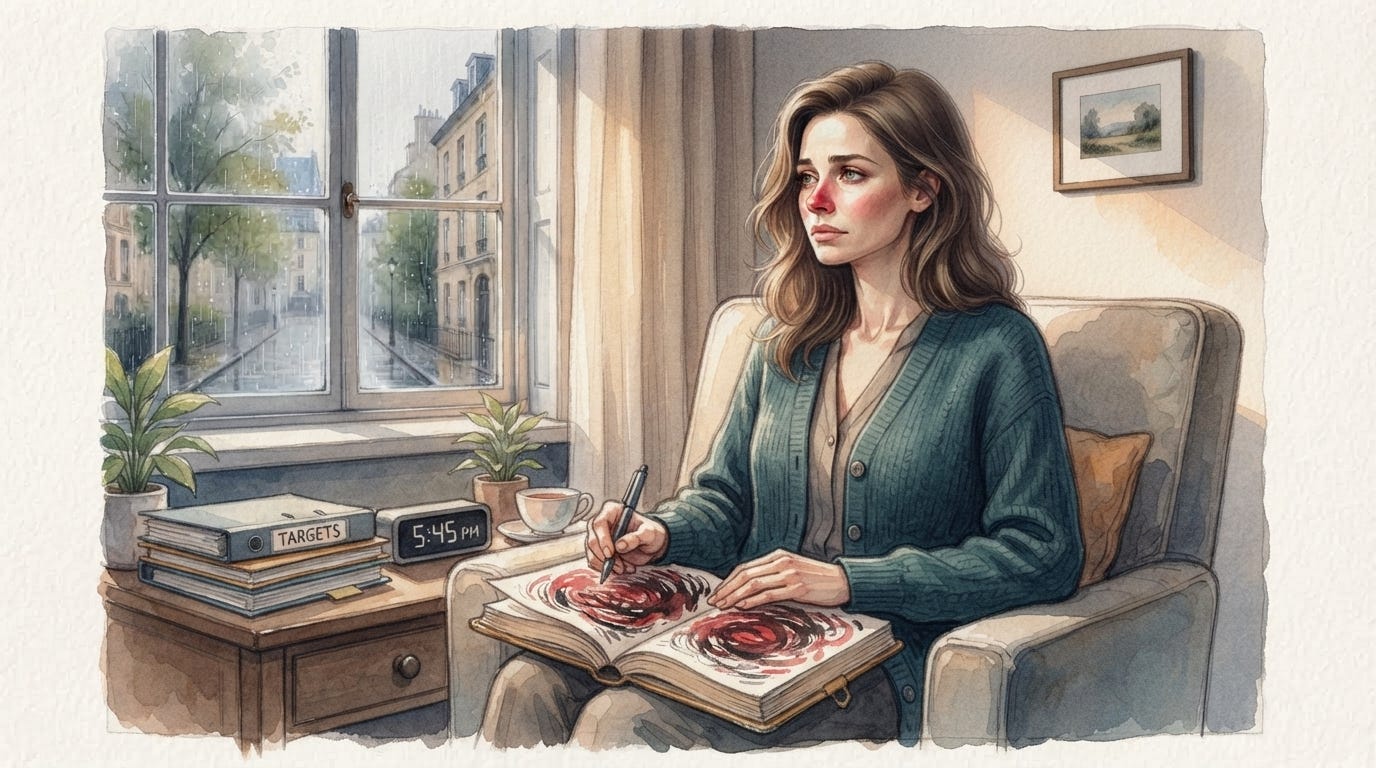
My journals knew before I did. When I flick back through them now, a lot of what I was feeling is written in red. One section looks like a dark red and black oil painting: heavy, thick and swirling, like a well or a pit of misery I couldn’t climb out of.
The strange part is that I didn’t see it as a crisis. Most of my life has felt “not the best,” so I assumed that was just what life felt like. When misery has always been your baseline, you don’t recognise it as misery. You think it’s normal and keep going.
The only time I felt something different was when I worked on my own passion projects. That’s when I found real joy, and it showed me what I’d been missing. But even those slipped away as I tried to pay the bills and keep my beautiful new home, the place that brought me peace. Holding on to it meant giving more of my time and energy to a job that was draining me.
If you’ve ever looked back at your own words and been shocked by how much pain was on the page, you’re not overreacting. Sometimes we only see how heavy it was once we’ve started to put it down.
It wasn’t just the sniffles
I’m overqualified for my role. I took a lower pay grade and fewer hours on purpose, to protect my mental health and have some work-life balance. When I told my sister, she warned me that reduced hours often turn into full days anyway. She was right. And on my day off? I’m recovering. Even that one day isn’t fully mine.
I work hard, and my income doesn’t move. I’ve realised that doing everything I’m told only means I lose more.
In counselling, I’ve been meeting someone else. She’s strong. She knows her rights, and she fights for herself and for others. At work, I have everyone’s back, and no one has mine. My manager is fine, mostly, and leaves me to it because I’m an expert. But being left alone isn’t the same as being supported, and “fine” doesn’t pay for the emotional labour of being switched on all day.
The old me and the new me are still working out how to share one body. The old me says keep your head down, you need this job. The new me says you’ve earned better than this. Both of them are trying to protect me.
Is it burnout, or is it a boundary?
I wondered whether I was just being lazy. I don’t think I am.
The World Health Organization describes burnout as an occupational phenomenon with three parts: exhaustion, mental distance or cynicism towards your job, and reduced effectiveness. I’m not diagnosing myself, but pulling away mentally after years of high alert can be a form of self-protection. It can also be the start of a boundary, even when it feels strange. I’m learning to separate two things:
Doing my job well, which I’ll keep doing.
Giving unpaid, unseen extra out of fear, which I’m starting to put down.
I’m not telling anyone to quit, because many of us can’t. I’m saying it’s worth noticing the difference.
What I’ve learned, and what’s helping
I don’t have this all figured out. But after three decades, here’s what’s genuinely helping, and what I’d tell a friend:
Notice your boom-bust pattern. When do you push hardest, and how many days does it take to recover? Writing it down makes it visible.
Protect one recovery day. If your day off is spent recovering, plan for that instead of pretending it’s free time.
Separate doing your job well from over-giving out of fear. Ask yourself which one you’re doing right now.
Journal, even messily. Looking back, I could see what I couldn’t feel at the time.
Let the learning land in its own time. You can understand something long before you can act on it. That isn’t failure.
Make rest-day food effortless. Prep something the night before so you’re not relying on energy you don’t have.
Get support. A therapist or GP can help you sort out what’s stress, what’s illness and what’s something else.
Why I’m sharing this
I’ve struggled for over three decades, mostly without the words for it. I thought I was lazy, too sensitive, or just bad at coping. I wasn’t. My nervous system was doing exactly what it learned to do.
I don’t want you to spend as long as I did figuring that out. If any of this sounds familiar, you’re not broken. You may just be tired of carrying armour nobody can see.
This isn’t medical advice, and what helped me may differ for you. If your low mood has been heavy for a long time, please talk to your GP or a therapist.
So I’ll leave you with the question I’m asking myself:
Are you simply tired, or have you been giving more than you’re given?
If you’re nodding along, you’re not alone. Tell me in the comments what your body has been trying to say.
Back to Part 1: Why I Got Ill the Moment I Finally Stopped →